CANNABIS
DeltaBev’s Giant Cannabis Drink Plant Meets a Milligram Cap
DeltaBev’s Canoga Park cannabis drink plant now packs hemp SKUs, just as a 0.4 milligram federal cap closes that grocery channel.

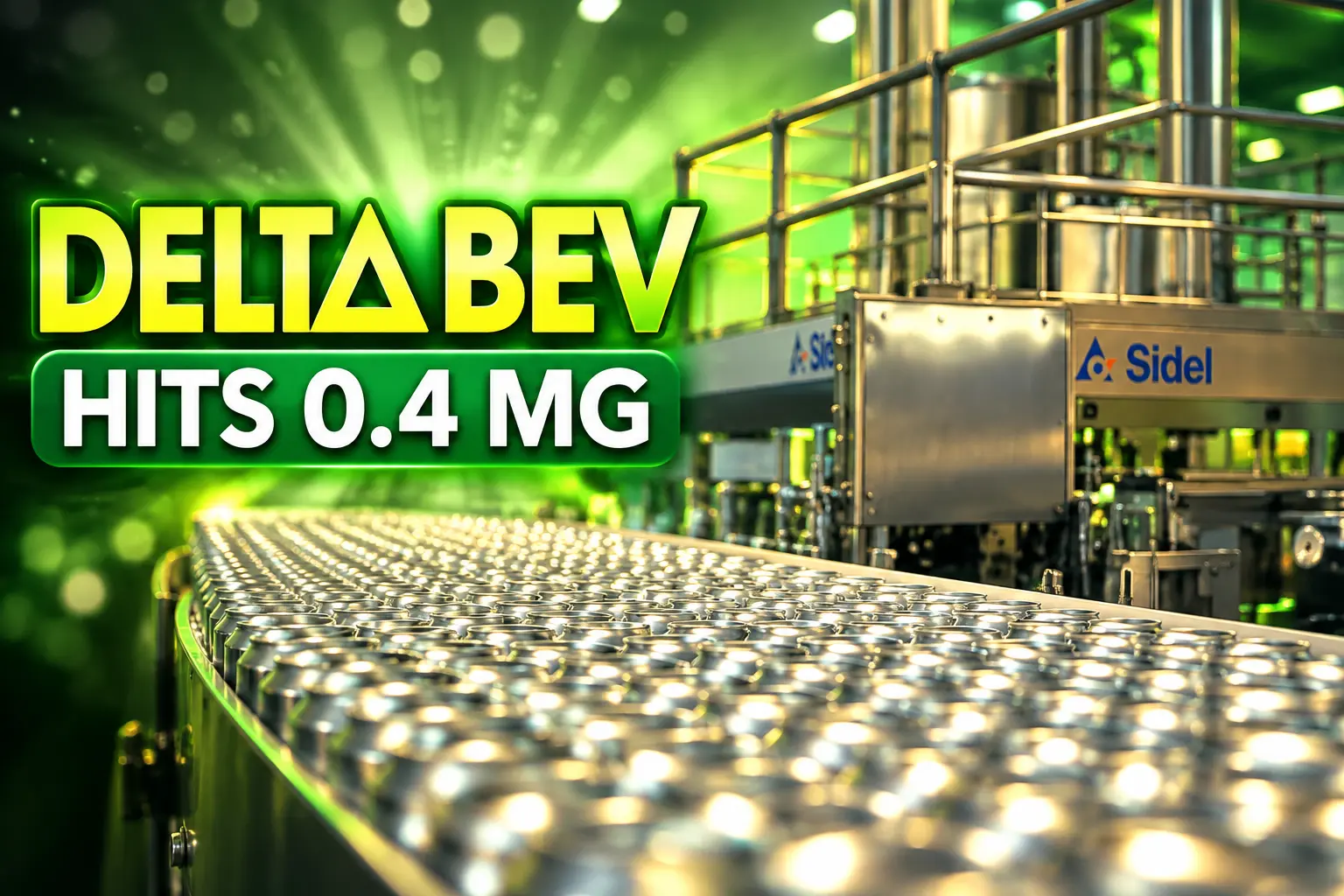
DeltaBev’s 45,000-square-foot cannabis beverage plant in Canoga Park now advertises hemp packing, more than two years after it opened. Blaze Life Holdings, the Los Angeles group that runs the line, called the plant the world’s largest cannabis drink factory by capacity when operations started in January 2024.
The same site now sells state hemp testing for products headed to the retail hemp market. Congress, in Public Law 119-37, rewrote the federal hemp definition so a finished can with more than 0.4 milligrams of total THC is no longer hemp.
A 45,000-Square-Foot Plant in Canoga Park
The building sits on a 1.67-acre corner lot in the San Fernando Valley, with 18-foot ceilings, shipping doors, and on-site warehousing. BLH said the plant runs canning, bottling, and smaller “mini” lines, and that it holds a full California license.
The 2024 release walked through the drink science in brewery language. Reverse osmosis water, de-aeration, inline emulsion injection, CO2 purging, and counter-pressure filling were listed as the tools for holding THC potency through a fill. The live site also flags tunnel pasteurization on the canning side.
Procurement was the commercial pitch. Baseline buying covers brite cans, lids, sugar, and basic preservatives, so a brand does not have to show up with its own metal. Distribution sits next door at SuLo Distro, BLH’s California cannabis wholesaler.
THE CANOGA PARK PLANT
| Item | Detail |
|---|---|
| Floor area | 45,000 square feet |
| Lot | 1.67 acres |
| Location | Canoga Park, Los Angeles |
| Ceiling height | 18 feet |
| Operations start | January 2024 |
| License claim | Fully licensed in California, per the company site |
German filler maker KHS was still featuring DeltaBev’s Innofill Can C line in August 2026, which is the cleanest public sign the hall is not a press-release shell. The partnership video is the look inside the rotary filler.
BLH’s own corporate site, blazelifeholdings.com, returned as an expired Squarespace page when checked. DeltaBev.com stayed up, and that is where the hemp language now lives.
Beer Veterans Bet on a Licensed Drink Line
Scott Kim, a Los Angeles real estate investor, and Paul Burgis, former chief operating officer and chief financial officer of Golden Road Brewing, founded BLH in 2017. Anheuser-Busch InBev had bought Golden Road in 2015. The pair said they wanted a cannabis group that ran like a craft brewery, not a grow warehouse with a soda fountain on the side.
The holding company stacked three pieces: ILLA Canna for cultivation, branded goods, and retail; SuLo Distro for California wholesale, including drinks; and DeltaBev for manufacturing. BLH said the group’s beer and beverage staff held a combined 80 years of production, distribution, and sales work.
Shreyas Balakrishnan, named as BLH’s chief executive in the February 1, 2024 release, sold speed and fewer handoffs, not a tasting room.
By streamlining our operations and eliminating unnecessary complexity, we are enabling downstream profitability and accelerating time to market, delivering fresher products to consumers faster.
Shreyas Balakrishnan, CEO, Blaze Life Holdings, February 1, 2024 release
He also said the drink category had not hit its “tipping point,” and that the company could not guess when interstate cannabis rules would move, only that the plant would be ready. That bet assumed the next wave of cans would still need a licensed California hall. Grocery hemp drinks, sold under the 2018 farm bill, were about to test that assumption.
Mary Jones, CANN and a Cheech Michelada
CANN was the first production partner when the line started. Mary Jones Soda, the cannabis arm of Seattle’s Jones Soda, then hired DeltaBev to co-make and SuLo Distro to place product in California shops. David Knight, Mary Jones’s chief executive, said Canoga Park would let the brand add drinks, gummies, and shots, and that SuLo would widen the dispensary map.
Jones Soda was an early mainstream packaged-goods name in California adult-use cannabis. In that 2024 announcement, the company said Mary Jones had grown sales more than 500 percent since a 2022 launch and ranked as the fifth-largest cannabis beverage brand in the state. Those figures were the brand’s, dated to that release, and they have not been refreshed here.
The same launch list pulled in smaller drink labels that did not own a brewery.
BRANDS NAMED IN THE 2024 LAUNCH
- CANN: First production partner on the new line.
- Mary Jones Soda: Jones Soda subsidiary; hired DeltaBev and SuLo Distro for California drinks.
- Sip Elixirs, CQ, Nevis Brands, Tinley’s: Additional co-manufacturing customers named by BLH.
- Bodega Coolers: Listed as an award-winning account on the same roster.
- Cheeche’lada: A cannabis michelada released with Cheech Marin.
That is a contract-packer’s book, not a house brand. The steel, the water system, and the California license are what a soda label rents. If those labels later ride hemp rules instead of a dispensary invoice, the same filler can, in theory, run a different SKU. DeltaBev’s 2026 homepage is written as if that switch already happened.
Why Grocery THC Left Dispensary Cans Behind
Hemp-derived THC drinks scaled in convenience stores, liquor shops, and some big-box coolers because the 2018 farm bill treated cannabis with no more than 0.3 percent delta-9 THC by dry weight as hemp, not marijuana. A wet can can clear that percentage and still carry a noticeable dose. Extractors also turned CBD into other intoxicating isomers, a path the Food and Drug Administration has mapped in its five things to know about delta-8.
Licensed California cannabis drinks still move through dispensaries, taxes, and state track-and-trace. Hemp cans did not. Minnesota let certified hemp drinks and foods go to adults 21 and over, and Target put THC drinks in some of its stores there. Craft breweries poured the same category on tap. Ryan Bandy, chief business officer at Indeed Brewing in Minneapolis, said THC drinks were close to one-quarter of the business. At Bauhaus Brew Labs, a few blocks away, those drinks were 26 percent of distributed-product revenue and 11 percent of taproom revenue.
Conference briefings in 2026 put 2024 THC drink sales above $1 billion, mixing licensed and hemp channels. A March 26, 2024 Pew Research Center survey found that 88 percent of U.S. adults favored legal marijuana in some form, and 57 percent favored both medical and recreational use. That is a mass cooler, not a club product, and grocery got there first.
THC DRINK FIGURES
- 2024 drink sales: Industry briefings used in 2026 put THC drinks above $1 billion that year.
- Indeed Brewing: THC drinks close to one-quarter of the Minneapolis brewery’s business, per Bandy.
- Bauhaus Brew Labs: 26 percent of distributed-product revenue and 11 percent of taproom revenue from THC drinks.
- Pew, March 2024: 88 percent backed some form of legal marijuana; 57 percent backed medical and recreational use.
The loud complaint around the coming federal cap is simple, and it is fair: a milligram rule aimed at hemp sodas leaves beer and liquor in the same aisle. Drink companies that spent 2024 and 2025 building grocery routes under the old dry-weight test now face months, not a multi-year phase-out. Licensed Canoga Park never had those grocery doors. It had California dispensaries, and then it added hemp paperwork.
California moved on its own. Gov. Gavin Newsom signed a bill in October 2025 to keep intoxicating hemp products out of ordinary retail and inside the licensed cannabis system. A plant that already holds a California cannabis license is, on paper, the hall those SKUs would have to use if they stay in the state at all.
The 0.4 Milligram Cap on a Finished Can
Public Law 119-37, the fiscal 2026 agriculture appropriations measure signed November 12, 2025, amends the hemp definition in 7 U.S.C. §1639o. The Congressional Research Service, in In Focus IF13136 updated August 17, 2026, walks through the new test. After the effective date written into that law, hemp is measured by total THC, including THCA, at no more than 0.3 percent on a dry-weight basis. Finished consumer products are separately capped at 0.4 milligrams of total THC per container, counting other cannabinoids with similar effects, in the innermost retail pack.
Anything over that milligram line is no longer hemp. It is marijuana under the Controlled Substances Act unless it is made and sold inside a state cannabis program. Fiber, grain, seed oil, and research hemp stay in the industrial bucket. Intermediate oils over 0.3 percent total THC-class content are out. So are cannabinoids a cannabis plant cannot make, and plant-native cannabinoids that were synthesized outside the plant.
CRS noted that the Food and Drug Administration was supposed to publish, within 90 days of enactment, lists of plant-native cannabinoids, THC-class compounds, look-alikes, and more detail on “container.” As of the August 2026 update, those lists had not gone out.
FROM FARM BILL TO MILLIGRAM CAP
- 2015: Anheuser-Busch InBev acquires Golden Road Brewing, Burgis’s former employer.
- 2017: Kim and Burgis found Blaze Life Holdings.
- 2018: The farm bill defines hemp as cannabis at or under 0.3 percent delta-9 THC by dry weight.
- 2022: Mary Jones Soda launches in California’s adult-use market.
- January 2024: DeltaBev starts Canoga Park operations with CANN as first partner.
- November 12, 2025: Public Law 119-37 is signed, rewriting the hemp definition.
- November 12, 2026: The new definition’s written effective date, including the 0.4 milligram finished-product cap.
Congress has already tried to slide that date. On August 8, 2026, the Senate passed a continuing resolution, H.R. 6500, that would delay most of the new definition until December 11, 2026, while still cutting synthetic cannabinoids on November 12. CRS said House versions of the stopgap and the fiscal 2027 agriculture bill did not include that delay. Other bills would pause the change for two more years or scrap it. The date on the signed statute remains November 12, 2026, until a later law actually moves it.
Sen. Mitch McConnell of Kentucky, who helped write the 2018 hemp language, backed the 2025 rewrite. He said it would keep “dangerous products out of the hands of children, while preserving the hemp industry for farmers,” and that industrial hemp and CBD would stay legal for industrial uses. The U.S. Hemp Roundtable, a trade group, has said the change puts more than 300,000 jobs at risk and could cost states $1.5 billion in tax money. Jonathan Miller, the group’s general counsel, argued that a year-long delay undercut any claim of an emergency.
It’s a big deal. It would be a mess for our breweries, for our industry, and obviously for a lot of people who like these things.
Ryan Bandy, chief business officer, Indeed Brewing
Drew Hurst, president and chief operating officer at Bauhaus Brew Labs, said he did not see a way for that company to stay in business if the milligram cap took effect as written. Those are Minnesota hemp-seltzer lines, not Canoga Park’s licensed hall. They are the volume the 2024 BLH release never named, and the volume DeltaBev’s website later tried to serve with hemp compliance testing before retail.
What a Licensed California Line Is Worth
A California-licensed filler with pasteurization, emulsion injection, and a sister distributor is what a drink brand needs if intoxicating hemp leaves gas-station coolers and has to live inside cannabis rules. It is also expensive idle plant if those brands simply die. DeltaBev’s 2026 copy tries to hold both jobs at once: cannabis co-packing for the state system, and hemp paperwork for whatever the federal definition still allows.
The 0.4 milligram finished-can cap is far below a social dose. A hemp soda that people buy to feel something does not survive that number as hemp. It survives as a licensed cannabis drink in a state that already allows adult use, made in a hall like Canoga Park, sold in a dispensary, and taxed as marijuana. Or it does not survive.
Balakrishnan’s 2024 line about being ready when interstate cannabis commerce arrives still sits on the old release. The nearer test is narrower. It is whether a 45,000-square-foot licensed plant that taught itself hemp compliance still has cans to run after November 12, 2026, if Congress leaves the milligram cap in place.
DeltaBev’s site still lists a California license, tunnel pasteurization, and hemp testing. The parent homepage is down. The milligram cap, as written in Public Law 119-37, takes effect November 12, 2026, unless a later statute actually moves it.
Disclaimer: This article is news reporting and analysis of a manufacturing plant and of federal hemp law. It is for information only and is not legal, medical, or investment advice. It does not tell anyone whether a drink, extract, or hemp SKU is lawful to make, sell, or consume in a given state, and it is not a recommendation to buy or sell any company’s securities or products. Readers who need to act on licensing, product formulas, or the milligram cap should consult a licensed attorney in the relevant state, and anyone using cannabis or hemp products for health reasons should speak with a qualified clinician. Figures, license claims, and effective dates reflect the company materials, Congressional Research Service analysis, and other sources cited above as of their publication dates and may change if Congress, FDA, or California regulators issue new rules.


The Justice Department Told Marijuana Testers They Lack Standing

The DEA Hearing Left Adult-Use Cannabis on Schedule I

Two Republicans Ask Treasury to Keep the Marijuana Tax Penalty

The Cannabis Banking Bill Sits Idle in Tim Scott’s Committee

Indiana’s Two-Ounce Marijuana Bill Died Without a Hearing
The Cannabis Banking Bill Sits Idle in Tim Scott’s Committee

Vermont Stripped Psilocybin Legalization and Still Has No Therapy Program

Cann Group’s $15 Million Obsidian Facility Ended in a Buyout

Demecan’s €100 Million Round Was a Sales Bet

Island Peži Heads to Mankato Without an Automatic Tax Break
-
 LAW5 months ago
The Cannabis Banking Bill Sits Idle in Tim Scott’s Committee
-
 LAW3 years ago
Vermont Stripped Psilocybin Legalization and Still Has No Therapy Program
-
 CANNABIS3 years ago
Cann Group’s $15 Million Obsidian Facility Ended in a Buyout
-
 CANNABIS2 years ago
Demecan’s €100 Million Round Was a Sales Bet
-
 MARIJUANA4 months ago
The DEA Hearing Left Adult-Use Cannabis on Schedule I
-

 MARIJUANA1 year ago
White House Drug Office Puts Lev Back on Medical Policy
-
 CANNABIS2 years ago
Island Peži Heads to Mankato Without an Automatic Tax Break
-
 MARIJUANA1 year ago
The SHIP Act Would Mail Cannabis Only After Prohibition Ends