
MARIJUANA
Question 8 Driving Ads Rest on One Ohio Morgue Study
A Virginia nonprofit funds Question 8 ads that cite an Ohio THC crash figure the study says legalization did not change.

Question 8 ads tell Massachusetts voters that 42 percent of drivers in fatal crashes test positive for THC. The figure is not a Massachusetts crash finding. It comes from coroner files in one Ohio county, and almost every dollar behind the ads comes from a Virginia political nonprofit.
High THC in dead drivers is a real warning, and nobody serious is arguing that it is safe to drive stoned. The leap the ads ask for is different: that legal weed made Massachusetts roads more dangerous, and that shutting licensed shops is the fix. The Ohio paper’s own before-and-after rates do not show that, and state OUI cases fell in 2025.
The Out-of-State Money Behind the Crash Ads
The Coalition for a Healthy Massachusetts is the only committee registered to pass Question 8. Filings with the Office of Campaign and Political Finance show it had raised $3,531,625 since it formed in September 2025, and that $3.48 million, or 98.5 percent, came from SAM Action Inc.
SAM Action is the 501(c)(4) political arm of Smart Approaches to Marijuana, the Alexandria, Virginia, group founded in 2013 by former U.S. Rep. Patrick Kennedy and Kevin Sabet, a former White House drug-policy adviser. As a social-welfare nonprofit it does not have to name its own donors. Its 2024 tax return listed $8.6 million in contributions, $1.17 million in spending, and $23 million in net assets. SAM has said it takes no money from the alcohol, tobacco, opioid, or prison industries.
SAM ACTION CHECKS TO THE YES COMMITTEE
| Date | Amount |
|---|---|
| September 23, 2025 | $750,000 |
| October 8, 2025 | $800,000 |
| May 8, 2026 | $875,000 |
| July 15, 2026 | $750,000 |
| September 29, 2026 | $305,000 |
| Total from SAM Action | $3,480,000 |
Those five transfers paid for signature gathering, then for the fall air war. The campaign had spent about $1.1 million on digital, radio, television, and other ads since mid-September, many of them built around impaired driving. Patrick Nestor, a Yes on 8 spokesman, said the cannabis industry is “eager to dismiss any study or reference about the undeniable fact that nationwide there has been an increase in marijuana drugged driving now more than 20 years ago.”
Sabet has made himself the national face of the measure. In a video he posted on October 23, he walked through the story of a Massachusetts woman who left physical therapy to work in an early dispensary and said cannabis took over her life, a pitch aimed at addiction and neighborhood shops rather than at crash tables.
Anne was told marijuana wasn’t addictive. She quit her job as a physical therapist to work at one of the first dispensaries in Massachusetts. Then it took over her life.
Her story isn’t rare. Communities with pot shops see more addiction, more youth use and more public drug… pic.twitter.com/FEXwz3ibem
— Kevin Sabet (@KevinSabet) October 23, 2026
The same week, the Yes committee’s own account talked about youth exposure, mental health, and public safety. The paid Massachusetts spots still lean on dead drivers. A Suffolk University poll of 500 general-election voters, taken October 14 to 17, found 71 percent opposed to Question 8 and 21 percent in favor, with a margin of error of 4.4 points. The buy is not waiting on local enthusiasm.
On the No side, money is coming from licensed operators, including Insa, Ascend Wellness Holdings, and Vireo Health, and from the Retailers Association of Massachusetts. Ryan Dominguez, executive director of the Massachusetts Cannabis Coalition and chair of the No on 8 campaign, has said the trade group’s line is unchanged: do not use cannabis and get behind the wheel. He has also said the impaired timeline after use is still an open research question.
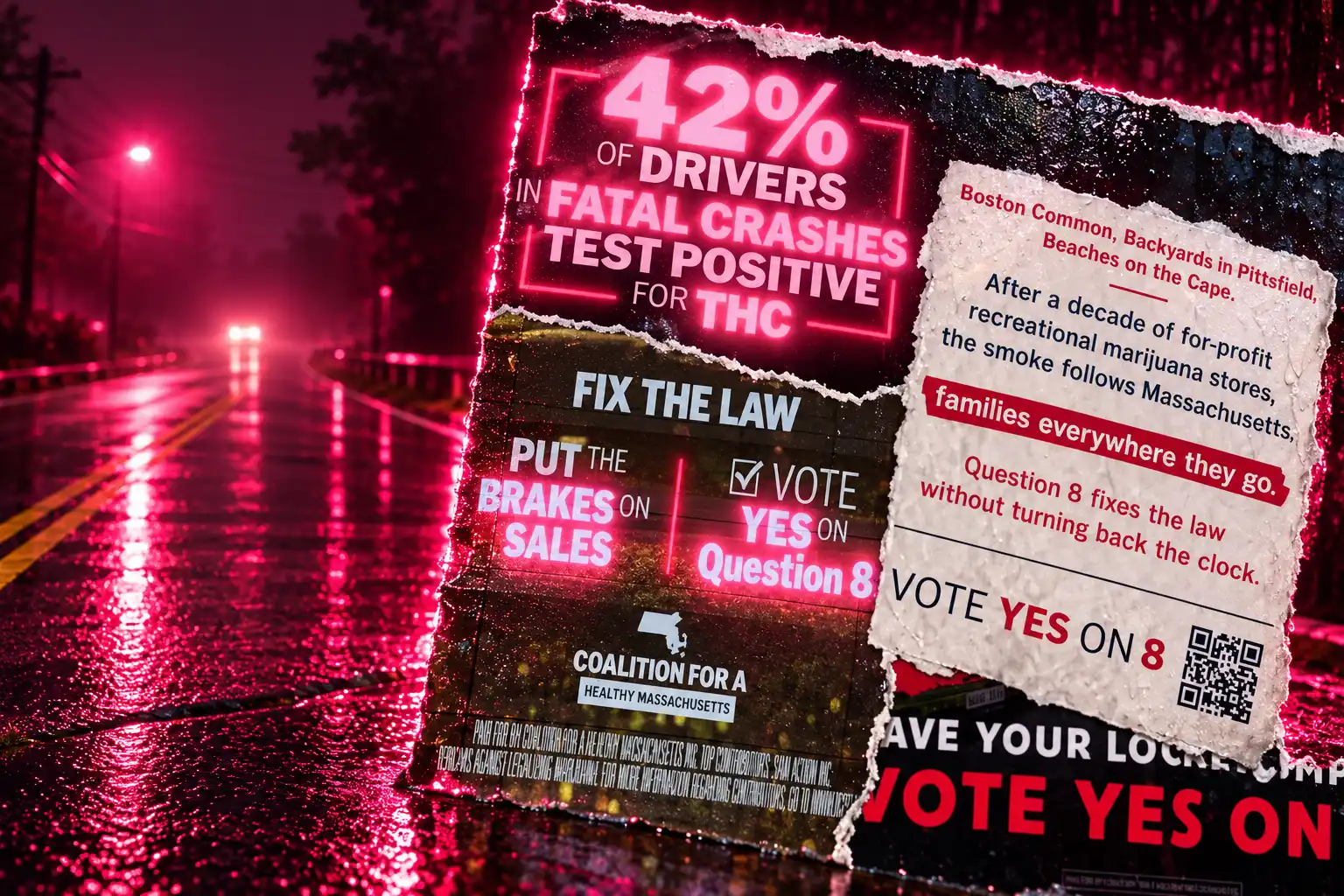
The 42 Percent Comes From One Ohio County Morgue
The number in the ads is a rounding of 41.9 percent. Akpofure P. Ekeh, a professor of surgery at Wright State University in Dayton, presented a six-year review of Montgomery County, Ohio, coroner records at the American College of Surgeons Clinical Congress in Chicago in October 2025. The work is an abstract, selected by a program committee and not yet peer reviewed.
Researchers looked at 246 deceased drivers who were tested for THC after fatal crashes from January 2019 to September 2024. One hundred three of them, or 41.9 percent, tested positive for active THC, with yearly rates between 25.7 percent and 48.9 percent. Drivers who tested positive had an average blood level of 30.7 ng/mL. Most states that set a numeric THC driving limit use a range of 2 to 5 ng/mL. Ohio legalized recreational cannabis in 2023, in the middle of the window.
I was surprised to see that level. An average level of 30.7 ng/mL generally means those people must have consumed marijuana at some time close to driving. This isn’t about residual use; it’s about recent consumption.
Akpofure P. Ekeh, professor of surgery, Wright State University, American College of Surgeons news release
Ekeh’s public-health line is blunt: treat smoking marijuana like alcohol, and do not smoke and drive. The same release, though, is the document Yes on 8 is least eager to quote in full. It found no change in THC positivity after legalization. The rate was 42.1 percent before Ohio’s 2023 law and 45.2 percent after, a difference the authors did not call significant. Nestor still called the paper “based on the reality of actively high drivers on our roads and increased dangers as a result.”
Lucy Xiaolu Wang, a University of Massachusetts Amherst professor who studies cannabis, said drawing conclusions from that out-of-state study for Massachusetts is “impossible,” because so few solid trials exist on drugs other than alcohol. Ekeh, talking about his own files, has said a THC-positive result does not always tell you the level of impairment.
Massachusetts Recorded Fewer OUI Cases in 2025
The Yes campaign’s website has used the line “DUIs RISING.” State crime data show 7,687 cases involving OUI arrests, for alcohol or drugs, in 2025, which was fewer than 2024, and 2024 was already a drop from 2023. Massachusetts has no per se THC blood limit. Cannabis OUI is charged under the same statute as alcohol, MGL Chapter 90, Section 24, and a conviction still requires proof of impairment, not a number on a lab slip.
THE CRASH CLAIM NEXT TO THE RECORD
| What the ads say | What the files show |
|---|---|
| 42% of drivers in fatal crashes test positive for THC | 41.9% of 246 tested dead drivers in Montgomery County, Ohio, 2019 to 2024 |
| Legalization made the roads more dangerous | Same Ohio paper: 42.1% THC-positive before legalization, 45.2% after, no significant change |
| Driving under the influence is on the rise in Massachusetts | 7,687 OUI cases in 2025, down from 2024 and from 2023 |
| Marijuana is now the most common drug in fatal accidents | NHTSA’s large Virginia Beach crash-risk study found no extra THC crash risk after age, sex, and alcohol were controlled |
Spots have also pointed to the 2016 death of state trooper Thomas Clardy and the 2018 deaths of four Stoughton teenagers, at the hands of drivers suspected to be high. Clardy was killed two years before the first adult-use shops opened on November 20, 2018. The campaign is not required to use Massachusetts wrecks that post-date licensed sales, and it has not built its 42 percent line from them.
Jane Allen, a research communication scientist at RTI International in Waltham, said two recent studies she considers well done show rates of marijuana-impaired driving falling, and that Yes on 8 did not cite them. “Because,” she said, “that research doesn’t say what they want.” A separate 2021-2024 analysis of the National Survey on Drug Use and Health, posted as a working paper, put self-reported marijuana-impaired driving down from 22.2 percent in 2021 to 19.3 percent in 2024. That is a survey of past-year behavior, not a crash file, and it still leaves a large share of users admitting they drove after cannabis.
What Question 8 Would Shut Down in 2028
A yes vote would prohibit the retail sale of adult recreational marijuana, end the state’s marijuana tax, and rewrite the Cannabis Control Commission so it regulates medical cannabis only. A no vote leaves current law in place. The statute is titled “An Act to Restore A Sensible Marijuana Policy,” and it would take effect on January 1, 2028, which means licensed shops would have a little more than a year to wind down if it passes on November 3, 2026.
The official summary is easy to misread as a full recriminalization. It is not. Possession of 1 ounce or less, including no more than 5 grams of concentrate, would stay legal for adults 21 and over, and gifting that amount to another adult would stay legal if it is not advertised. Possession of 1 to 2 ounces would be a $100 civil penalty and forfeiture. For people under 21, 2 ounces or less would be a civil infraction with a $100 fine, forfeiture, a drug-awareness program, community service, and notice to a parent. Medical marijuana would continue under Chapter 94I. Adult-use licensees could apply on an expedited basis to become medical dispensaries and sell leftover inventory to them.
WHAT THE MEASURE KEEPS AND KILLS
- Licensed adult-use shops: Retail sale, production, testing, and the marijuana excise go away when Chapters 94G and 64N are repealed.
- Home grow: Chapter 94G is also the statute that lets adults cultivate at home, so that right goes with the shops.
- Possession: One ounce or less stays legal for adults 21 and over; 1 to 2 ounces becomes a $100 civil fine.
- Medical cannabis: The patient market stays, tax-free, with the commission narrowed to that job.
- Social consumption: New cafe-style licenses the commission approved at the end of 2025 would die with the adult-use code.
Massachusetts would be the first state to repeal a voter-approved adult-use market. The secretary of the commonwealth certified 78,301 signatures to put the question on the ballot. Licensed shops posted more than $1.65 billion in adult-use sales in 2025, about $3 million above 2024, across 46.3 million transactions. The Department of Revenue recorded $289 million in state sales and excise tax in fiscal year 2025 from the 6.25 percent sales tax and the 10.75 percent marijuana excise, money the legislature has steered to the MBTA, school building, social-equity grants, and substance-use programs. Host towns may add a local option tax of up to 3 percent.
Chair Shannon O’Brien said 2025 left the state with the highest number of cannabis businesses since adult-use sales began. Executive Director Travis Ahern said staff were preparing for social consumption and for new research if the federal government reschedules cannabis. Question 8 would cut that path off at the statute book, while leaving a legal possession lane that still has to be supplied by someone.
THC Blood Tests Still Cannot Prove a Driver Was High
The scientific fight is not over whether cannabis can slow a driver. Simulator work keeps finding extra lane weave, slower reaction, and more time below the speed limit after THC, with the worst window in the first several hours after inhalation. Combined use with alcohol is worse than either drug alone. NHTSA’s public line is that marijuana can slow reaction time, hurt distance judgment, and cut coordination, and that it is illegal everywhere to drive impaired by it.
The fight is over what a blood number means on a Massachusetts ballot flyer. THC can linger in the body for days or weeks in frequent users, which is why a positive test after a wreck is not the same fact as a 0.08 alcohol reading. In the federal crash-risk study run in Virginia Beach, drivers with THC were overrepresented in crashes at first glance, but once age, sex, and alcohol were held constant, researchers found no increase in crash risk associated with THC. Drivers at 0.08 alcohol were about four times more likely to crash than sober drivers; at 0.15 the multiple was about 12. A positive drug result, NHTSA notes on the same study page, does not necessarily mean the driver was impaired at the time of testing.
A December 2025 paper in Clinical Chemistry put a finer point on the legal shortcuts. After short abstinence, many regular users still exceed per se THC cutpoints used in other states, including 43 percent at a 0.5 ng/mL zero-tolerance line and 24 percent at 2 ng/mL, with no difference in simulated driving between people over those lines and people under them. Massachusetts never adopted those cutpoints. The Yes ads still talk as if a morgue percentage were a breathalyzer.
WHERE EXPERTS DISAGREE
- Ekeh’s morgue file: Average 30.7 ng/mL looks like recent use, and he wants the same social rule as alcohol, but his own before-and-after rates did not move after Ohio legalized.
- Wang at UMass Amherst: The Ohio abstract cannot be stretched into a Massachusetts causal claim; too few strong trials exist, and modern dispensary products barely resemble the old research crop.
- Allen at RTI: Cannabis can dull thinking on the road, and the studies that show impaired-driving rates falling are the ones the campaign leaves out of the spots.
Weekend-night roadside surveys still found more THC-positive drivers in 2013-2014 (12.6 percent) than in 2007 (8.6 percent), a 48 percent rise NHTSA has used in its own education campaign. Presence rose. Crash risk after the usual controls did not. That gap is what a 42 percent slogan is built to hide.
The Mississippi Farm That Still Shapes the Science
Pretty much everyone in the Massachusetts argument, including regulators and industry people, has said they want more research on impaired driving. The bottleneck is federal. For decades, legal studies had to use plants from a single University of Mississippi farm. Wang has said that crop had, by 2017, become a non-intoxicating variety, hemp, unlike the pre-rolls and gummies on Massachusetts shelves, and that scientists have deduced “basically nothing” about modern consumption as a result.
HOW THE EVIDENCE GOT THIS THIN
- 2000 to now: A National Library of Medicine tracker counts 21 clinical trials on THC and driving; Wang says most are not randomly controlled gold-standard trials.
- 2017: The long-running Mississippi research crop had become hemp, a plant that does not match current dispensary potency or product types.
- October 2025: Ekeh’s Montgomery County abstract is presented at a surgical meeting, then recycled into Massachusetts television as if it were a statewide road study.
- January 2026: Cannabis Control Commission leaders said that without a planned Center for Cannabis Research and Policy with UMass Amherst, the commission cannot accept funds for several research grants it has already been awarded.
If Question 8 passes, that center becomes harder to justify, not easier. The campaign is using a research vacuum that federal prohibition created as a reason to rebuild a sales ban, while promising that public health will improve on the strength of a paper that did not find a legalization effect in Ohio and of OUI totals that fell in Massachusetts.
Voters decide Question 8 on November 3, 2026. If yes wins, licensed adult-use shops would close under the new statute on January 1, 2028, possession of an ounce would remain legal, and the crash number on the ads would still describe one county morgue in Ohio.
Disclaimer: This article is news reporting and analysis of a Massachusetts ballot measure and of published research on cannabis and driving. It is informational only and is not legal advice, medical advice, or a voting recommendation. It does not tell anyone whether to use cannabis, whether to drive, or how to mark a ballot, and it is not a substitute for advice from a licensed attorney, a physician, or another qualified clinician. Readers who need help with a criminal charge, a medical condition, or a workplace or licensing question should consult a professional who can review their facts. Figures, poll results, campaign totals, and the status of Question 8 reflect the filings, agency releases, and studies cited here and can change before or after the November 3, 2026 election.

Cannabis Sales Tracked With Faster Heart Hospitalizations in the West

Question 8 Driving Ads Rest on One Ohio Morgue Study

The Justice Department Told Marijuana Testers They Lack Standing

The DEA Hearing Left Adult-Use Cannabis on Schedule I

Two Republicans Ask Treasury to Keep the Marijuana Tax Penalty

The Cannabis Banking Bill Sits Idle in Tim Scott’s Committee
The Justice Department Told Marijuana Testers They Lack Standing

Vermont Stripped Psilocybin Legalization and Still Has No Therapy Program

New Brunswick’s Cannabis Crackdown Stops at the Reserve Line

DeSantis Used a Cannabis Vote to Lock In Florida’s CFO
-
 LAW7 months ago
The Cannabis Banking Bill Sits Idle in Tim Scott’s Committee
-
 LAW5 months ago
The Justice Department Told Marijuana Testers They Lack Standing
-
 LAW3 years ago
Vermont Stripped Psilocybin Legalization and Still Has No Therapy Program
-
 LAW3 years ago
New Brunswick’s Cannabis Crackdown Stops at the Reserve Line
-
 MARIJUANA1 year ago
DeSantis Used a Cannabis Vote to Lock In Florida’s CFO
-
 MARIJUANA5 months ago
The DEA Hearing Left Adult-Use Cannabis on Schedule I
-

 CANNABIS2 years ago
Demecan’s €100 Million Round Was a Sales Bet
-

 CANNABIS3 years ago
Cann Group’s $15 Million Obsidian Facility Ended in a Buyout