
CANNABIS
Cannabis Grow House Signs: A Guide for Neighbors and Landlords
A cannabis grow house shows several signs at once, from smell and sealed windows to heat and fans. Check them from the street and report without going inside.

You keep noticing the house next door: covered windows through the afternoon, a sweet smell in the side yard, or a fan that never seems to stop.
A cannabis grow house is an ordinary home turned over to indoor plants, lights, and fans. Call when those details stack up, and stay on the footpath while you do it.
The signs start with what you can see from the street, then the clues only a landlord can check, the risks that reach the people next door, and the report to make.
How Do You Spot a Cannabis Grow House From the Street?
The setups police describe fill rooms, not a single pot on a balcony. Plants grown indoors under lamps, with fans and water gear, take about three months, and the strong smell arrives in the final weeks. Crime Stoppers Australia says most of those crops are found because a passerby or a neighbor catches that smell.
The scent is often called sweet and sickly, and some police descriptions add a skunk-like edge. It is heavier than one person smoking on a porch, and it can hang around the side of a house even when the windows look shut. A smell that shows up once and fades is a weak clue on its own. A smell that returns for days, with another sign beside it, belongs in a report.
Covered glass is the visual partner to that smell. Curtains drawn all day, panels, sheeting, or a full blackout are there to hide bright lamps. Light still leaks. A white rim at the window edge, a glow from a roof space, or lamps that click on in the middle of the night fit the pattern Crime Stoppers describes, including lights left on 24 hours a day and lamps on a timer while the house looks empty.
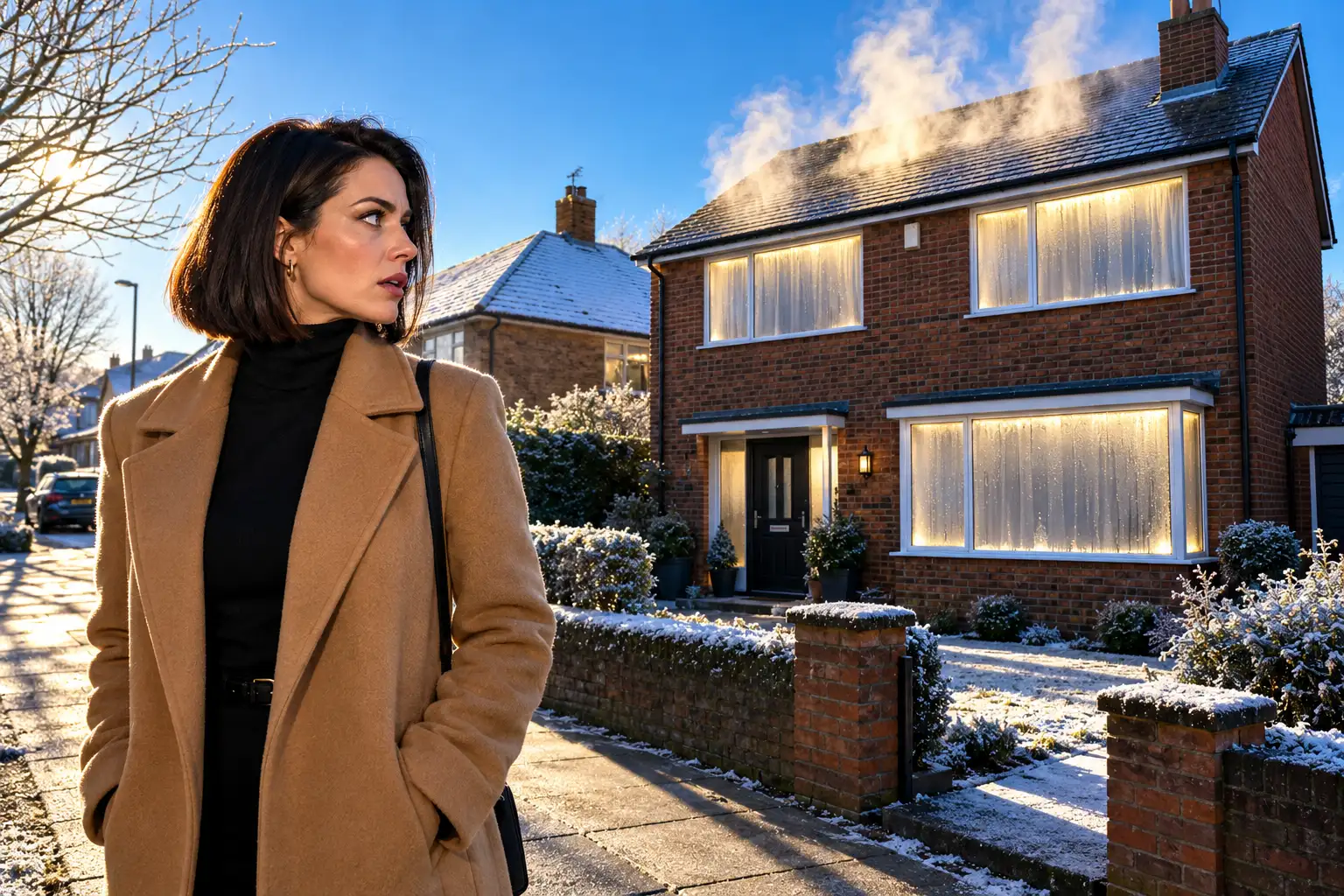
Heat is harder to hide than light. Rooms held like a greenhouse throw condensation onto the glass even when the day is not cold, and a landlord inside may find damp walls or wallpaper pulling away. On a frosty morning the roof can stay bare while the other roofs on the street turn white, because the space under it is too warm for frost to settle. Snow that melts faster than it does next door, and birds gathering on the roof in cold weather, sit on the same heat list from Crimestoppers in the UK.
Sound travels through a shared wall or a side fence. A fan or an electrical hum that runs through the day and the night is listed as ventilation for the plants. Heavy security stands out most on a quiet street: a padlocked gate, two or three locks on the door, bars on the windows, cameras on the path, or a beware-of-dog sign on a house that otherwise looks ordinary.
| Sign | Who can notice it | An ordinary cause |
|---|---|---|
| Sweet, sickly, or skunk-like smell that returns | Neighbors and people walking past | Someone smoking nearby, or a smell that fades the same day |
| Windows covered, boarded, or blacked out all day | Anyone on the footpath | A night-shift sleeper, or privacy covering on one room |
| Condensation on a mild day, or a frost-free roof | Neighbors; landlords also see damp inside | Laundry, cooking steam, or a heated attic |
| Bright light at all hours, or light on a timer | Neighbors after dark | A porch lamp, or a room used for late work |
| Fan noise or a hum day and night | Neighbors who share a wall or fence | A bathroom fan left on, or a heat pump |
| Extra locks, bars, cameras, or a padlocked gate | Anyone passing | A house that was recently broken into |
| Many unfamiliar faces at odd hours, or almost nobody home | Neighbors over several days | Shift work, a large family, or a short stay |
| Odd cables, hoses, or pipes; a meter that looks altered; a bill that jumps or crashes | Neighbors may see cables; landlords see the bill | A renovation, or a seasonal heater |
| Abandoned vehicles, piled mail, compost bags, or toys with no children | Neighbors over time | A holiday, or a family that is simply out |
Hoses and pipes in strange places, chemical containers, and diverted power are also on the NSW Police list of drug house signs. A bill that suddenly rises or falls is the landlord clue on the Australian list: either the meter has been bypassed, or another address has been tied into the supply. Treat an opened, taped, or rewired meter box as a reason to call, not as something to handle.
Visitors cut both ways. A stream of new faces at odd hours can be a busy household, and it carries more weight when ordinary life is missing: no bins, no one collecting mail, people who slip in through the garage and leave after a short stop. The opposite pattern matters too. Some houses look empty for days, then get a brief visit. Abandoned vehicles, unauthorized electrical work, boarded-up windows, and a constant cannabis smell are the four signs ACT Policing named on 29 September 2026.
Some houses try to look lived in. A radio or television left running, outdoor lights, flyers sitting on the step, or bikes and toys outside when no child lives there are props used to deflect suspicion. They matter when the rest of the building still looks shut. A grow can also sit behind a quiet front: people have walked past for days, caught no smell at all, and only later seen lights and sacks coming out after police arrived.
ABC News filmed a short walkthrough of these street clues with ACT police, which is worth watching before you decide what you actually saw.
STAY ON YOUR SIDE OF THE FENCE
- The door: Do not knock, and do not confront anyone at the address.
- The yard: Do not cross the boundary to peer in windows or to inspect a meter.
- The wiring: Do not touch cables, a meter box, or anything that looks altered.
- Your notes: Write the address, the time, and what you could see from the street or another public place, then call.
You will not have every row in that table, and you do not need to. A suspicion plus the details you could see from a public place is enough for police to take the next step.
Why Can a Grow House Put the Neighbors at Risk?
Those street signs matter because the hazard does not stay inside one set of walls. Lamps, dehumidifiers, and heaters draw a heavy load. When the wiring is altered so the power company is not measuring that load, the connections can start a fire that spreads into the next home. Damp heat feeds mould. Amateur rewiring can shock anyone who touches it. Chemicals used around the plants can build up in the air.
RISKS THAT REACH PAST THE FRONT DOOR
- Fire: Tampered electrics plus a heavy power load can ignite and move into nearby homes.
- Shock: Rewiring done by someone unqualified can leave a dangerous electrical hazard.
- Mould and fumes: Greenhouse heat and humidity can grow toxic mould, and chemicals can linger in the air.
- A weak floor: Plants kept upstairs can rot floorboards until there is a risk of collapse.
- People on site: A child who lives there or visits can be around those hazards, and some workers are trafficking victims held against their will.
- Traps and theft: These houses can draw robberies aimed at the crop, sometimes called grow rips, and traps are sometimes set to stop them.
The trap point is a reason to stay out, not a detail you need to investigate. Police warn that a trap can seriously injure or kill a visitor or a firefighter. The same warning covers children who live in the house or only come to visit. The person you glimpse at the door may be tending plants for someone else, and Crimestoppers notes that some of those workers are victims of human trafficking.
On 3 November 2025, officers followed a cannabis smell to a flat in Bootle and found 24 plants across two rooms, plus an electricity supply that had been tampered with. Chief Inspector Jordan Quinn of Merseyside Police says the risk lands on the people who live and work nearby.
“Cannabis farms in neighbourhoods pose a real risk to nearby residents who not only have to put up with the anti-social behaviour associated with this criminality, but also the risk of a fire being ignited from illegally extracting electricity.”
Jordan Quinn, Sefton Neighbourhood Chief Inspector, Merseyside Police
Fire, mould, shock, fumes, robbery, and harm to children are set out together in the dangers the RCMP lists for illicit grows. That is also why the instruction in Canada is short: do not investigate, and contact local police. The neighbor’s stake is the shared wall, not a duty to confirm what is in the rooms.
What Should Landlords Look for in a Rental?
Neighbors see the shell of the building. You are the person who can tell whether anyone actually lives in it, and rental houses are a common pick because the water damage and the rewiring land on someone else’s property. A scheduled inspection is how empty rooms show up. A surprise confrontation is not.
Rental Applications That Do Not Add Up
False paperwork often fails small checks, which is the point of doing them before you hand over keys. Victoria Police tells rental providers to compare the story on the form with the documents, and to verify the employer rather than trusting the number the applicant typed.
- The household: The form says a family is moving in, but no children appear anywhere in the application.
- The contact details: The email looks newly made, such as a first name, a last name, and a string of numbers, or the phone is not even connected.
- The job: You look up the employer yourself, call that number, and check that a payslip business number matches the company name.
- The money: Rent is offered for several months up front, cash is pushed with no clear reason, or the power bill is to stay in your name.
- The history: References are missing or thin, which both Canadian police advice and UK tenant warnings flag before you accept the let.
None of those points proves a crop. A cash payer can be legitimate, and a thin reference can be a first rental. They are reasons to slow down, ask for certified identification, and keep the right to inspect in the lease.
What Can You Check on a Lawful Inspection?
Blinds kept shut, blacked-out windows, extra cables outside, objects in the yard that never move, an overgrown lawn, and occupants you rarely see are listed in the crop house advice Victoria Police gives rental providers, updated 24 January 2025. Inside, the same page tells you to notice smells of cannabis, fresh paint, or bleach, the last two because they can be used to cover the first.
A lived-in kitchen has plates. A lived-in bathroom has toothbrushes. Bedroom cupboards have clothes that match the ages on the application, including children’s clothes if children were part of the story. The person who opens the door should match the photo identification from the application. While you are there lawfully, note vehicle plate numbers and whether cameras have appeared, including a doorbell camera. Refused inspections, even after proper notice, and locks that have been changed so you cannot get in, are tenant warnings Crimestoppers publishes for letting agents.
LEAVE ONCE A LIVE CROP IS LIKELY
- The visit: Do the inspection you scheduled with notice, and look for ordinary signs that someone lives there.
- The stop: If you meet sealed rooms, a constant fan, or wiring that looks altered, end the visit and call police.
- The door: Do not force entry, do not argue with the occupants, and do not touch the electrical gear.
Victoria Police also says no issue is too small to report. In an emergency, or if you need police there now, the number in Australia is 000. For a non-urgent case in Victoria, the Police Assistance Line is 131 444. Anonymous reports go to Crime Stoppers on 1800 333 000. You can leave your name out, and Crime Stoppers Australia says a reward can still be available.
How to Report a Suspected Cannabis Grow House
Once you have more than one sign, the useful move is a report made from where you already stand. The Royal Canadian Mounted Police puts it plainly: any one sign may not be a concern, and more than one is a reason to notify police. You are not asked to prove the case.
- If someone is in danger now: Smoke, sparks, a burning smell, or a person hurt means the emergency number where you live. In Australia that number is 000. Do not try to put out an electrical fire yourself.
- If it is not an emergency: In Australia, call Crime Stoppers on 1800 333 000 or report at crimestoppers.com.au. In Victoria, non-urgent police help is also 131 444. In the UK, the anonymous Crimestoppers number is 0800 555 111. In Canada, contact local police and do not investigate.
- Say what you know: Give the address, the signs you saw together, the times, and any vehicle details you could read from a public place. Say if you think a child is there.
- Stop: Do not go back for a better look, do not post the address as a public accusation, and do not wait for a perfect set of clues.
Police would rather have an early, partial note than a fire call later. The Bootle flat was found because someone acted on a smell. Your version of that call can be two signs and a street number.
What Else Can the Same Clues Mean?
A stack of signs is still not a verdict you have to deliver. A night worker can keep curtains closed until noon. A house that was burgled can grow new locks and a camera. Condensation can be a wet bathroom and a cold morning. The table above is there so you do not treat one row as a finished story.
A lawful cannabis business is a different building from a rented house with every window sealed. In Canada, the Cannabis Act has allowed a regulated legal market since 2018, while organized crime groups have stayed in the illicit market beside it. What counts as a lawful personal plant, a licensed site, or a criminal crop depends on the country and the state. You do not have to draw that line. The federal page on cannabis laws in Canada is where Canadian readers can read the legal side, and local police can sort a small lawful grow from a house converted into a crop.
Use pairs, not single impressions. Smell plus sealed windows, a fan plus a frost-free roof, or odd-hour visitors plus cables that do not look like a normal repair are the kinds of combinations police lists are built for. One covered window on a quiet street is something plenty of homes have. If the only thing you ever observe is a smell that never returns, you can still mention it, and you can also keep watching for a second sign before you decide the house is more than odd.
Frequently Asked Questions
Can You Report a Cannabis Grow House Without Giving Your Name?
You can leave your name out. An anonymous report is allowed, and a reward can still be available afterward. In the UK, the phone line and the online form are set up so caller ID is not shown and the computer address is not traced.
Should a Landlord Go Inside Before Calling the Police?
Do the inspection you have already set with proper notice, because missing plates, missing toothbrushes, and a face that does not match the photo ID are hard to judge from the street. Once sealed rooms, a nonstop fan, or altered wiring make a live crop likely, leave and call the police. Do not force the door and do not argue with the occupants.
Are the People Inside a Grow House Always the Ones in Charge?
The person you see is not always the one running the grow. Some people found working in these houses are trafficking victims kept there against their will, and a child who lives there or visits can be around the damp, the fumes, and the bad wiring. Tell the police if you think a child is inside, and leave the welfare check to them.
What If the Only Sign Is a Smell and Nothing Else?
A smell on its own is a reason to watch, not a finished case. Note whether it stays day after day and whether covered windows, fan noise, or odd visitors show up with it. You can still pass on a smell by itself, and the police decide whether it is enough.
What Should You Do if You See Smoke, Sparks, or an Unsafe Meter?
Call the emergency number where you live, and do not touch the meter, the cables, or the front door. In Australia that number is 000. Get yourself and anyone with you to a safe distance, and let the fire crew judge the wiring.
Write the address, the time, and each sign you can already see from public space. Then make the call and let police take the next step.
Disclaimer: This article is an educational guide to public warning signs for suspected illegal cannabis growing in a home, and it is information only. It is not legal advice, tenancy advice, or a direction to enter a property or to handle electrical equipment. Speak to local police about a suspicion, and speak to a qualified lawyer before you rely on a lease or a right of entry. Phone numbers, reporting rules, and safety guidance reflect the public sources used for this page and can change.

The Justice Department Told Marijuana Testers They Lack Standing

The DEA Hearing Left Adult-Use Cannabis on Schedule I

Two Republicans Ask Treasury to Keep the Marijuana Tax Penalty

The Cannabis Banking Bill Sits Idle in Tim Scott’s Committee

Indiana’s Two-Ounce Marijuana Bill Died Without a Hearing
The Cannabis Banking Bill Sits Idle in Tim Scott’s Committee

Vermont Stripped Psilocybin Legalization and Still Has No Therapy Program

New Brunswick’s Cannabis Crackdown Stops at the Reserve Line
The Justice Department Told Marijuana Testers They Lack Standing
The DEA Hearing Left Adult-Use Cannabis on Schedule I
-
 LAW6 months ago
The Cannabis Banking Bill Sits Idle in Tim Scott’s Committee
-
 LAW3 years ago
Vermont Stripped Psilocybin Legalization and Still Has No Therapy Program
-
 LAW3 years ago
New Brunswick’s Cannabis Crackdown Stops at the Reserve Line
-
 LAW4 months ago
The Justice Department Told Marijuana Testers They Lack Standing
-
 MARIJUANA4 months ago
The DEA Hearing Left Adult-Use Cannabis on Schedule I
-

 MARIJUANA1 year ago
White House Drug Office Puts Lev Back on Medical Policy
-

 CANNABIS3 years ago
Cann Group’s $15 Million Obsidian Facility Ended in a Buyout
-
 MARIJUANA5 months ago
Two Republicans Ask Treasury to Keep the Marijuana Tax Penalty