
LAW
New Brunswick’s Cannabis Crackdown Stops at the Reserve Line
Bill 29 added seizure powers and $5,000 fines, but New Brunswick’s minister said the law cannot reach First Nations shops, where 74 of 107 illegal stores sat.

New Brunswick counted 107 illegal cannabis stores on April 1, 2024, and Health Minister Bruce Fitch said 74 of them sat in First Nations communities. Public Safety Minister Kris Austin said the bill written to close those shops cannot address the First Nations problem, because provincial officers cannot seize property on reserves.
Bill 29 still passed. Inspectors gained peace-officer powers, landlords faced new fines, and the Crown could forfeit seized cannabis. The shops Fitch had just counted in First Nations communities sat outside that design.
The Minister Said the Bill Stops at the Reserve Line
Austin had already used the same line in November 2023, when reporters asked why some unlicensed shops were raided and shops on First Nations land were not. He called those stores “an issue, no question. Very frustrating.” He said the province was stuck until Ottawa changed federal law.
You can’t seize property on First Nations reserves unless you’re talking about a property that would be involved in violent crime.
Kris Austin, Public Safety Minister of New Brunswick, March 2024
“Our understanding is when it comes to cannabis that we’re not able to do that,” he said after Bill 29 was introduced. He added a sharper verdict on the bill itself: it “cannot address the problem on First Nations” and “goes beyond provincial jurisdiction.”
Indigenous Services Canada sent questions to the RCMP. The force called the file “complex.” That is the posture New Brunswick has kept, through a change of government, whenever the talk turns from off-reserve storefronts to shops on reserve land.
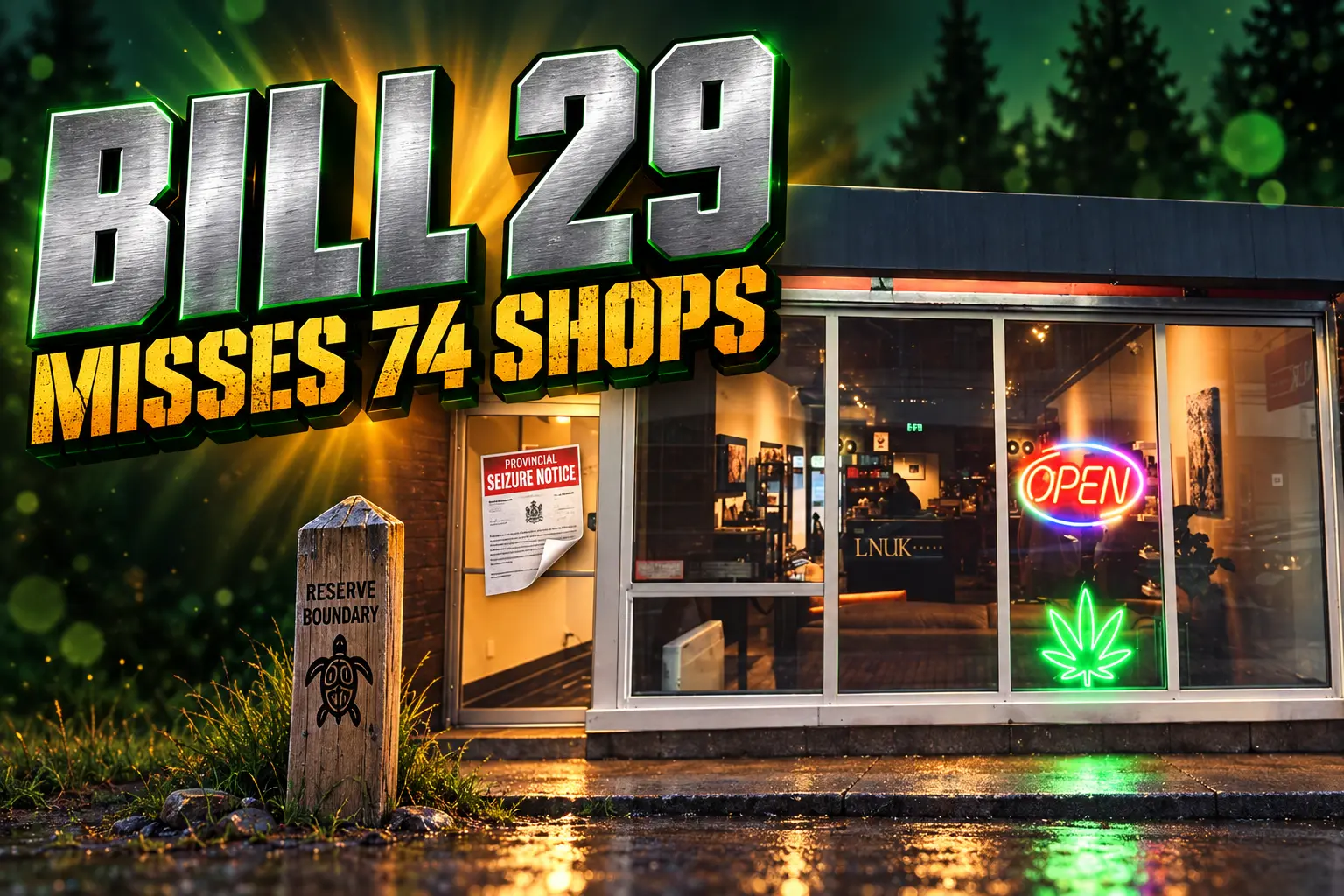
What Bill 29 Added to Inspector Powers
The Higgs government tabled Bill 29, An Act Respecting Cannabis Control, on March 26, 2024. Fitch, then health minister and the bill’s sponsor, said illegal dispensaries were an offence and that the province needed stronger tools to investigate and punish them. “Greater compliance is required to ensure the product is regulated and to keep it out of the hands of youth,” he said.
The bill received third reading on May 15, 2024, and was assented to on June 7, 2024, as 2024, c. 10. It did not add a First Nations clause. It did add landlord bans and new seizure powers aimed at ordinary commercial premises.
POWERS ADDED UNDER BILL 29
- Peace-officer status: Inspectors carrying out the Act hold the powers and immunities of a peace officer under the Criminal Code.
- Wider entry: They may enter and inspect a place, premises, or vehicle tied to the Act, plus connected rooms, and they may buy product, take samples, and open packages.
- Seizure and forfeiture: Cannabis, documents, other things, and even a vehicle can be seized; cannabis is forfeited to the Crown and destroyed.
- Landlord offence: No landlord may knowingly allow a place to be used for illegal cannabis sale, with a $5,000 minimum fine.
- Store and seller fines: Operating an illegal store carries a $5,000 minimum; selling illegal cannabis without running a store carries $2,000.
Provincial rules still say only Cannabis NB stores are legal, along with Cannabis NB approved retailers. Every other dispensary is illegal in the province’s own guide. Age checks, health warnings, child-resistant packs, and an excise stamp are how a buyer is told the product went through that system.
Peace officers said they had investigated and shut down 23 illegal dispensaries in the fiscal year that was ending as the bill was tabled. Some of those files involved people from First Nations communities. Some of the shops reopened.
74 of 107 Illegal Shops Were in First Nations Communities
Fitch gave the committee the map the bill would not redraw. As of April 1, 2024, he said, 107 illegal cannabis stores were operating in New Brunswick. Of those, 74 were operating in First Nations communities. He did not say the new statute would change that. When MLAs Robert McKee and Kevin Arseneau asked how the law would apply to those shops, he talked about overlapping federal and provincial rules and did not give a yes-or-no answer.
WHERE THE STORES SAT IN APRIL 2024
| What Fitch and the Crown counted | Number |
|---|---|
| Illegal cannabis stores in New Brunswick | 107 |
| Of those, in First Nations communities | 74 |
| Illegal stores outside those communities | 33 |
| Cannabis NB corporate stores at the time | 25 |
The 74 figure is Fitch’s community count, not a survey of legal title. Some Indigenous-owned shops sit off reserve, on ordinary commercial streets, and those have been raided. The shops on reserve are the ones Austin said provincial seizure cannot touch. Either way, the illegal market the bill was sold as fixing was already clustered where the minister said the bill could not go.
Section 89 of the Indian Act Bars the Seizure
Austin was not inventing a courtesy. In 2023 he pointed to “federal statutes that are there in terms of seizing property on First Nations” and said that until those statutes change, “we’re stuck as a province to be able to seize any property on First Nations.”
Section 89 of the Indian Act is that statute. It bars seizure of property on a reserve belonging to an Indian or a band, except by an Indian or a band. The text covers charge, pledge, mortgage, attachment, levy, seizure, distress, or execution. Courts have read it as a real limit on who can take control of on-reserve businesses, not a loophole a province can write around in a cannabis bill.
Violent crime is the exception Austin named, because a Criminal Code investigation is a federal police file, not a provincial inspector walking in with a Cannabis Control Act warrant. That is why a 2021 raid on the Medicine Cabinet, a shop on Eel River Bar First Nation, was an RCMP operation, and why the band’s then chief, Sacha Labillois-Kennedy, was described as having authorized it. Officers took more than $60,000 in cannabis, four rifles and shotguns the family said were for hunting, Interac machines, and cash. The brothers, their father, and a worker were held more than 10 hours. Charges against the father and son were later dropped.
The same seizure bar has shaped the tobacco trade on reserves for decades. In August 2026, after officers announced they had taken 4.3 million illegal cigarettes in four weeks, provincial officials were asked why shops on First Nations that sell unstamped tobacco and unlicensed cannabis still sit in plain view. They talked about investigating crime, not people, and about trying to bring retailers into the licensed system. They did not announce storefront raids on reserve.
Off-Reserve Indigenous Shops Face Court and Eviction
The enforcement pattern is geographic. Off reserve, including shops run by First Nations members who argue treaty rights, inspectors and police have gone in. On reserve, New Brunswick has treated cannabis as Ottawa’s problem unless a file is dressed as organized crime.
HOW THE TWO TRACKS WERE BUILT
- 2018: The federal Cannabis Act splits production and possession rules to Ottawa and retail to the provinces, and does not name First Nations, Inuit, or Métis governments as a third authority.
- March 26, 2021: RCMP raid the Medicine Cabinet on Eel River Bar after the chief’s authorization; later charges against the father and son are dropped.
- Spring 2023: The L’Nuk Lounge opens on Main Street in Moncton, off reserve, and its owners argue Peace and Friendship Treaties protect the trade.
- November 2023: Austin says federal seizure statutes leave the province stuck on First Nations land.
- March 26 to June 7, 2024: Bill 29 is introduced, passed, and assented to without a reserve clause, after Fitch’s 107/74 count.
- February 2025: A court rejects the L’Nuk claim that those treaties create a right to sell unlicensed cannabis; the shop had already been evicted from Main Street.
- April 26, 2026: RCMP search a cannabis warehouse and a home on Madawaska First Nation as part of a three-province organized-crime file, not a provincial inspector sweep of storefronts.
The L’Nuk owners said raids on their former Moncton premises cost them half a million dollars in product and cash. They moved to Riverview and kept the treaty argument. “We will do anything in our power to keep exercising our rights,” they said. In April 2026, after another raid, protesters gathered outside Public Safety’s regional centre in Moncton.
Del Riley, a former national chief of the Assembly of First Nations who has worked with First Nations cannabis retailers, told that crowd the rights were “totally intact” and that they were proving it in court. He accused the province of trying to keep First Nations people out of the country’s economy. The legal system, so far, has split the difference: treaty language has not shielded an unlicensed shop on a city street, and provincial seizure still stops at the reserve boundary Austin named.
Madawaska shows the other track. The First Nation passed its own cannabis and tobacco law in 2023, aimed at a regulated local market and at keeping criminal groups out. Storefronts there have included Smoke Signal, The Gram, and the Maliseet Pot Shop. On March 30, 2026, Indigenous Affairs Minister Keith Chiasson and Luke Randall, the minister responsible for Cannabis NB, toured Madawaska Warehouse. On April 26, RCMP came back with a warrant as part of a file that also hit locations in Ontario and Nova Scotia. Chiasson said the raid would not hamper talks with First Nations about a cannabis framework.
Cannabis NB Still Fights for Half the Market
The licensed system is the party Bill 29 was written to protect, and it is the party that has to price against shops the province will not seize. Cannabis NB, the Crown retailer, now lists 32 corporate stores plus private outlets. In the first quarter of 2026-2027, its private retail channel grew from 11 locations to 13.
That is a larger legal footprint than the 25 corporate stores counted in March 2024. It has not produced the capture rate the rest of the country claims.
THE LEGAL TILL, IN THE CROWN’S OWN FIGURES
- Fiscal 2024-2025: $100.9 million in sales and $23.1 million in net income, the last year of unbroken post-legalization growth.
- Fiscal 2025-2026: net income fell to $20.9 million, the first annual drop.
- First quarter to June 28, 2026: $25.4 million in sales, down 2.0%, and $4.6 million in net income, down 20.4%.
- Share of use: CEO Lori Stickles told a standing committee in October 2025 that 38 to 54% of consumption was going through regulated sources, against an estimated 78% for Canada.
Stickles has tried to close the gap with access and with price. The Crown opened more stores, including a 32nd location in Moncton, and put private shops into towns that lacked a corporate outlet. In the first quarter of 2026-2027 it sold 100,000 of a $2 Tuesday pre-roll, a product aimed at buyers who already have a cheaper unlicensed option down the road.
The legal product is the one with the stamp, the lab test, and the age check. The unlicensed shop does not have to carry that cost. When 74 of the province’s counted illegal stores sit in First Nations communities, and the public safety minister has said the seizure law cannot go there, Cannabis NB is not competing with a few holdout dealers. It is competing with a parallel retail map.
The Cannabis Act Never Named Indigenous Governments
The hole Austin ran into is written into federal law. An expert panel appointed to review the Cannabis Act reported in March 2024 that the federal Act is silent on Indigenous authority. The panel, chaired by Morris Rosenberg, said First Nations, Inuit, and Métis were not adequately consulted when the Act was built, and that the silence hurts public health, public safety, and a fair shot at the legal industry.
While the Act defines the authorities of the federal government and provincial and territorial governments, it is silent on the authority of First Nations, Inuit and Métis governments with respect to cannabis.
Expert Panel on the Legislative Review of the Cannabis Act, March 2024
The panel asked Ottawa to co-develop amendments so interested Indigenous governments could make nation-to-nation agreements on commercial cannabis, with minimum health and safety standards. It also asked Ottawa to amend the Indian Act’s definition of “intoxicant” so band councils can pass cannabis bylaws, and to make those bylaws enforceable by police and prosecutors. British Columbia, Ontario, Quebec, and Saskatchewan already have statutes that let them strike retail agreements with First Nations. New Brunswick was not on that list.
Other provinces talk a harder line on paper. British Columbia has called its cannabis statute a law of general application that covers First Nations land, then hesitated to test that claim in court. Nova Scotia has raided shops that invoked Mi’kmaq rights and has seen highway blockades. New Brunswick said the quiet part in 2023 and 2024, then wrote a bill that matched the confession.
The Holt Liberals, elected in late 2024, did not reverse Austin’s legal reading. They changed the politics around it. Chiasson said in May 2026 that talks with First Nations on cannabis had been underway for about six months, after the province struck new tax-sharing deals with all 15 First Nations. Some communities, he said, want a Cannabis NB-style model. Some want to write their own rules. “Our government wants to have those discussions and build a path that brings in safe, regulated cannabis to all people in New Brunswick,” he said.
That is a negotiation, not a seizure plan. Public Safety Minister Robert Gauvin has declined to discuss the Madawaska file. The shops on reserve remain a federal problem in provincial language, a treaty economy in the operators’ language, and a price competitor in Cannabis NB’s quarterly reports.
Bill 29 gave inspectors more ways to close a shop they are allowed to enter. Austin had already told the province which shops that would not be. Fitch’s own count had already said how many of the illegal stores sat on the other side of that line. Two years of new stores, $2 pre-rolls, and talks with chiefs have not repealed section 89, and they have not written Indigenous governments into the Cannabis Act.
Disclaimer: This article is news reporting and analysis of cannabis law and enforcement in New Brunswick. It is for information only and is not legal advice, licensing advice, or guidance on whether any shop, product, or land is lawful to operate or buy from. Anyone facing charges, considering a retail licence, or relying on treaty or Indian Act arguments should speak with a lawyer who practises in this area before acting. Figures, shop counts, court outcomes, and government positions reflect the public statements and documents cited and may change as talks, raids, and legislation move.

The Justice Department Told Marijuana Testers They Lack Standing

The DEA Hearing Left Adult-Use Cannabis on Schedule I

Two Republicans Ask Treasury to Keep the Marijuana Tax Penalty

The Cannabis Banking Bill Sits Idle in Tim Scott’s Committee

Indiana’s Two-Ounce Marijuana Bill Died Without a Hearing

Vermont Stripped Psilocybin Legalization and Still Has No Therapy Program

Demecan’s €100 Million Round Was a Sales Bet

Cann Group’s $15 Million Obsidian Facility Ended in a Buyout

Identifying Cannabis Grow Houses: Key Signs to Watch For

White House Drug Office Puts Lev Back on Medical Policy
-
 LAW3 years ago
Vermont Stripped Psilocybin Legalization and Still Has No Therapy Program
-
 CANNABIS3 years ago
Cann Group’s $15 Million Obsidian Facility Ended in a Buyout
-
 CANNABIS2 years ago
Demecan’s €100 Million Round Was a Sales Bet
-
 NEWS2 years ago
Identifying Cannabis Grow Houses: Key Signs to Watch For
-
 MARIJUANA1 year ago
White House Drug Office Puts Lev Back on Medical Policy
-
 CANNABIS2 years ago
Ascend Wellness Kept Its 2024 Bosses and Lost Sales
-

 CANNABIS2 years ago
DC Padlocked Green Cloud, Then Licensed the Same Owner
-

 CANNABIS2 years ago
Pipeline’s Cannabis Concert Plan Is Still a 2025 Promise