
MARIJUANA
The SHIP Act Would Mail Cannabis Only After Prohibition Ends
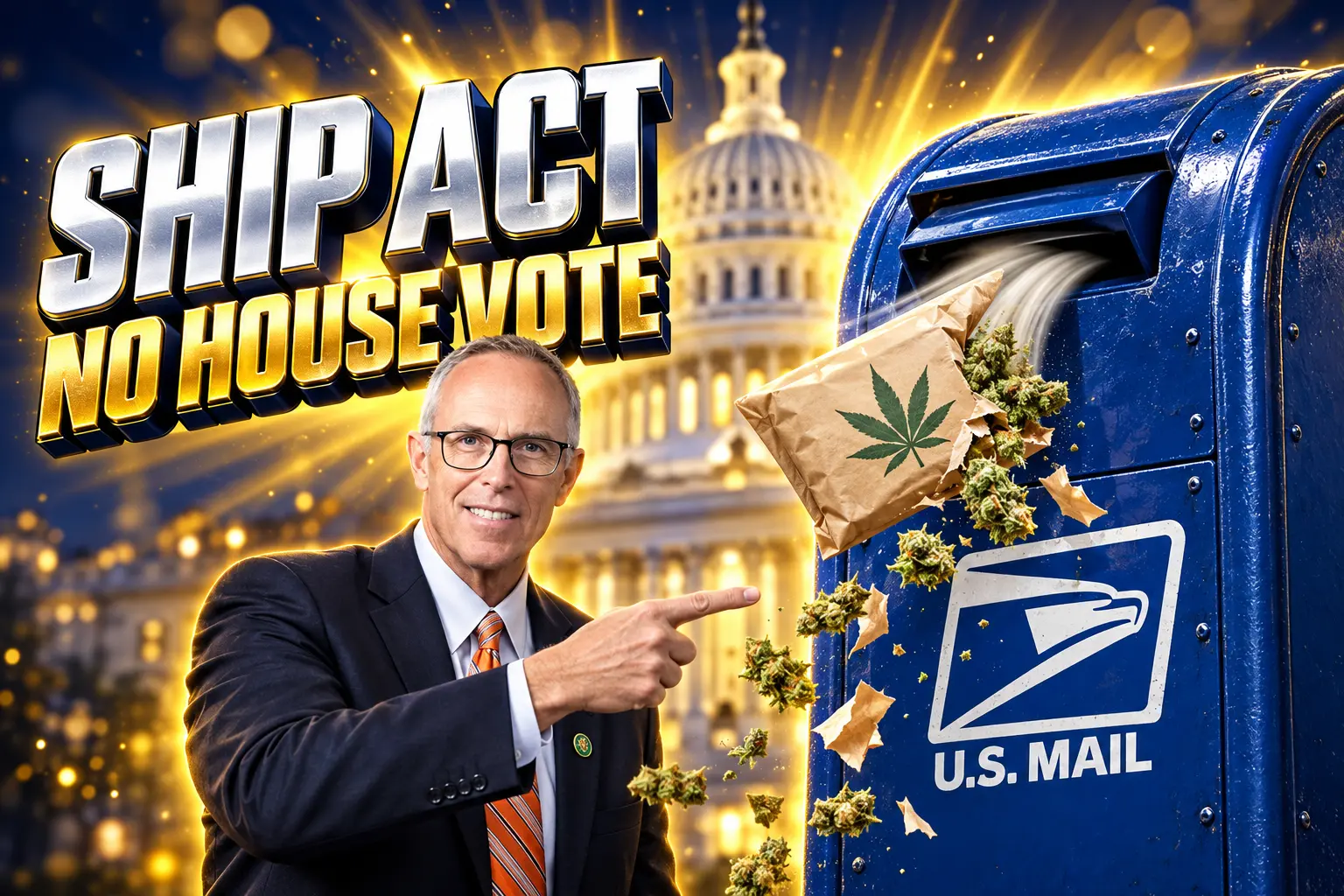
Huffman’s SHIP Act would let small cannabis farms use USPS only after full descheduling, and House committees have not voted since July 2025.

Rep. Jared Huffman’s SHIP Act would let small cannabis farms use the U.S. Postal Service, but only after federal prohibition is fully repealed. H.R. 4595 has sat in four House committees since July 22, 2025, with no hearing and no vote.
Huffman, a California Democrat, filed the Small and Homestead Independent Producers Act with Rep. Val Hoyle of Oregon as his only listed co-sponsor. The text is short, and it is built around a switch that has not flipped.
A Switch That Flips Only After Descheduling
Section 7 says the Act, and the mail changes it makes, take effect on the date cannabis is removed from the list of scheduled substances under the Controlled Substances Act, and federal criminal penalties for making, distributing, or possessing cannabis are eliminated. A move to a lower schedule would not start the clock. The penalties have to come off too.
That is why friendly posts about the filing kept circling the same catch. The mailing power is a contingent right. It does not exist while cannabis stays on the federal schedules, and it does not exist while those criminal penalties stay on the books.
WHAT WE KNOW
- The filing: H.R. 4595 was introduced in the House on July 22, 2025, and referred the same day to four committees.
- The trigger: The bill stays dark until cannabis is taken off the federal schedules and the related criminal penalties are repealed.
- The carriers: The text names the Postal Service and any private or commercial interstate carrier, with deliveries limited to adults 21 and older.
WHAT IS UNCONFIRMED
- A package deal: Nothing in the public bill file shows SHIP attached to a broader descheduling vehicle.
- Private freight: UPS, FedEx, and other commercial carriers have not said they would take state-legal cannabis if Congress opened the door.
- Porch checks: The bill requires age verification but does not spell out how a carrier would handle a refused delivery or a fake ID on a doorstep.
On July 22, 2025, Huffman reintroduced the bill to protect small farmers and said larger commercial operators were already squeezing local growers. He argued that when the federal ban is finally repealed, Congress should have a law ready so the smallest farms are not left behind. The readiness project has not moved past referral.
Huffman Drew the Line at One Outdoor Acre
The bill does not open the mail to every licensed grower. It writes hard size caps and delayed effective date rules that decide who counts as small, and those caps are the whole filter.
A small cultivator is a person who grows one acre or less of mature flowering canopy outdoors, 22,000 square feet or less in a greenhouse, or 5,000 square feet or less indoors, counting all cannabis that person grows. A small manufacturer is a person who makes products such as salves, tinctures, edibles, or concentrates with yearly gross revenue under $5 million, counting all of that person’s cannabis products.
THE SIZE LIMITS IN H.R. 4595
| Who can ship | Cap in the bill |
|---|---|
| Outdoor grower | One acre of flowering canopy or less |
| Greenhouse grower | 22,000 square feet or less |
| Indoor grower | 5,000 square feet or less |
| Product maker | Under $5 million in yearly gross revenue |
Outdoor, greenhouse, and indoor are defined by lighting, not by marketing copy. Outdoor means no artificial light or heat in the canopy, though light deprivation is allowed. Greenhouse means more than zero and no more than six watts per square foot. Indoor means more than six watts. Canopy is the area that holds mature, flowering plants at any point in time. Inclusive-of-all-cannabis language is there to stop an operator from splitting rooms or licenses to sneak over the line.
The outdoor cap sits on the same one-acre line California already uses to separate large cultivation groups from everyone else. The indoor cap is tighter. A 6,000-square-foot indoor room would miss the SHIP definition even if the same operator’s outdoor patch fit under one acre.
Large Farms Hold 65 Percent of California Canopy
Huffman’s district fight is easiest to see in California license data, because that is where large outdoor groups and legacy hillside farms share one legal market. Higher Origins, which builds its maps from state license records, puts 65 percent of California’s licensed canopy in the hands of 224 operators who each control more than one acre. Those operators are 7 percent of owners.
CALIFORNIA CANOPY BY FARM SIZE
| Farm group | Share of canopy | Who holds it |
|---|---|---|
| Large farms, more than 1 acre | 65 percent | 224 operators, 7 percent of owners |
| Medium farms, 10,000 square feet to 1 acre | 22 percent | The band between the dataset’s small cutoff and the one-acre line |
| Small farms, 10,000 square feet or less | 13 percent | 1,268 operators, 40 percent of owners |
The dataset’s small-farm cutoff is 10,000 square feet, which is not the SHIP outdoor cap. A half-acre sun grower can qualify as small under Huffman’s bill and as medium in that California tally. The political point still lands: a thin owner class already controls most of the state’s licensed production.
Shelf space is thinner than canopy. In a Higher Origins menu snapshot, confirmed small-farm products were 0.16 percent of 997,393 available SKUs across 924 stores, a counted floor of 1,605 items, not a claim that every other jar came from a large farm. About 36 percent of active retailers are tied to cultivation, distribution, or other supply-chain licenses, which gives some chains a say in what reaches the counter.
Local bans close the rest of the door. In the same snapshot, 301 of 540 Department of Cannabis Control jurisdictions prohibit both storefront and delivery retail, and 16,189,017 residents live in those places. Direct mail is the workaround Huffman is trying to federalize, and it is the channel those cities do not currently have to honor.
What a Small Farm Could Put in the Mail
A qualifying small grower or maker in a state where that work is lawful could ship cannabis or a cannabis product to an adult in that state or in another state where that adult may legally possess it, using the Postal Service or a private interstate carrier, with age checks at delivery. Flower is included. So are manufactured products named in the bill.
Federal law still treats mailing marijuana as a crime, and the major carriers still refuse the packages. SHIP tries to cut that knot by amending section 1716 of title 18, the injurious-articles statute, to direct the Postal Service to permit cannabis in the mails to the extent the Act allows, under regulations the Postal Service would write.
HOW A QUALIFYING PACKAGE WOULD MOVE
- Two legal ends: The sender must be a qualifying small grower or maker in a state where that work is lawful, and the buyer must be in a state where that person may possess the product.
- Any listed carrier: The Postal Service or any private or commercial interstate carrier may take the freight once the Act is in force.
- Age 21 at the door: No delivery to anyone under 21, with a check through a reliable online age service or a valid, unexpired government ID, including tribal ID.
- Transit through dry states: A prohibition state could not block a package that is only passing through on the way to a legal destination.
- No local shipping veto in legal states: In a state that does not ban cannabis for everyone, SHIP would override state laws that restrict direct shipment to a person who may legally possess it.
The last two bullets are the part retailers will hate, because they punch through the in-state bottle neck that now keeps every gram inside one licensed maze. The first three are the part compliance officers will spend years writing rules around, because a postal regulation and a driver’s-license scan are easier to put on paper than to run on a wet porch at dusk.
Maine Already Sells Craft Flower by Mail
Huffman’s press packet leaned on a state that already uses direct-to-consumer sales as a small-farm tool. Mark Barnett, co-founder of the National Craft Cannabis Coalition and policy director at the Maine Craft Cannabis Association, said Maine’s DTC setup helps support nearly 1,700 cultivators in a state of 1.2 million people. Without those sales paths, he said, quality in the legal market suffers and buyers look elsewhere.
Maine is not a federal model. It is a state-legal channel inside one set of borders, and it still cannot put a jar in a USPS bin bound for Oregon. The SHIP Act is the attempt to copy that farm-to-door logic onto the national mail stream after the federal ban falls, which is why craft groups treated the filing as a survival bill rather than a novelty.
Ross Gordon, co-founder of the National Craft Cannabis Coalition and a policy analyst at Origins Council, put the stakes in the same release. Nearly 15 years into state-level legalization, he said, small and craft producers are being pushed to the margins, patient access is shrinking, and the industry is consolidating into a few hands.
Without direct-to-consumer shipping, federal cannabis legalization risks reinforcing these failures instead of correcting them. The SHIP Act is a make-or-break policy for the future of small cannabis businesses in California and across the country.
Ross Gordon, National Craft Cannabis Coalition and Origins Council, Huffman press statement
Frederika McClary Easley, president of the Minority Cannabis Business Association, tied the same mailing right to “plant deserts” created by city opt-outs and zoning walls. If the mail can reach an adult who may possess the product, a ban on storefronts stops being a total cutoff. That is the consumer-facing case. The farm-facing case is simpler: a hillside grower who cannot buy end-cap space still might buy a postage meter.
The endorsement list around those quotes ran through national trade groups and county grower alliances, including the National Cannabis Industry Association, the Drug Policy Alliance, Parabola Center, the Humboldt County Growers Alliance, the Mendocino Cannabis Alliance, the Trinity County Agricultural Alliance, and craft associations in Washington, Vermont, and Maine. Hoyle remained the only House co-sponsor on the introduced text.
Preemption Would Punch Through State Retail Walls
Section 4 is the sleeper. In a state that bans cannabis for everyone, SHIP would not force sales. It would only protect transit to a legal destination. In a state that already allows possession, the Act would override state laws that restrict interstate or in-state shipment straight to a lawful adult, except for age limits.
Read that on a California map and the local-control fight changes shape. A city that voted down dispensaries could still see craft flower arrive in a mailbox, so long as state possession law is on the buyer’s side and the sender fits the size caps. Licensed shops that paid for scarce retail permits would face a second shelf they do not own. Vertically integrated chains that already steer 36 percent of California storefronts would lose some of the gate they use to keep small-farm SKUs at 0.16 percent of a counted menu.
Dry states become corridors rather than customers. A truck or a postal sack could cross them toward a legal porch, which is the inverse of today’s enforcement picture, where a state line is the crime. Highway patrols and postal inspectors would be asked to tell a transit package from a drop. The bill does not write that field manual.
Large multi-state operators are the other losers on paper, because the mailing right is denied to anyone over the canopy and revenue lines. In practice they already have licensed stores in several states, which is a different kind of interstate business, built one license at a time. SHIP would not let them mail from a 50-acre desert farm. It would let a one-acre sun grower skip their shelf.
Four House Committees Have Not Voted
The same-day referral on July 22, 2025, sent H.R. 4595 to Energy and Commerce, Agriculture, Oversight and Government Reform, and the Judiciary. The official tracker still lists the bill as introduced. There is no recorded hearing, markup, or floor vote in that file.
Larger, commercialized cannabis operators are infiltrating the market and squeezing out our local farmers in the process. So when the antiquated federal prohibition on cannabis finally gets repealed, we need to have substantial legislation ready to help these small businesses survive.
Rep. Jared Huffman, SHIP Act press statement, July 22, 2025
Full repeal is still a separate fight. On July 16, 2026, Sen. Cory Booker introduced S.5022, the Cannabis Administration and Opportunity Act, a Senate bill to deschedule cannabis, with Sens. Chuck Schumer and Ron Wyden among the lead names, and the text went to the Finance Committee. That vehicle is the kind of CSA removal SHIP is waiting on. It is not a substitute for a House vote on the mailing power itself.
Until both things exist, a small farm can still grow under state law and still cannot put flower in the mail. Huffman wrote the postage rules first and left them sitting in four committees, with the switch taped down, while the canopy numbers in his home state already show who is holding the acres.
Disclaimer: This article is news reporting and analysis of pending federal legislation and is for information only. It is not legal advice and it does not tell any person or business to ship, sell, or possess cannabis in violation of current federal or state law. Anyone making decisions about cannabis sales, mailing, licenses, or compliance should consult a licensed attorney in the relevant state before acting. Bill text, committee status, scheduling under the Controlled Substances Act, and carrier rules can change as Congress, courts, and agencies act.

The Justice Department Told Marijuana Testers They Lack Standing

The DEA Hearing Left Adult-Use Cannabis on Schedule I

Two Republicans Ask Treasury to Keep the Marijuana Tax Penalty

The Cannabis Banking Bill Sits Idle in Tim Scott’s Committee

Indiana’s Two-Ounce Marijuana Bill Died Without a Hearing

Vermont Stripped Psilocybin Legalization and Still Has No Therapy Program

Demecan’s €100 Million Round Was a Sales Bet

Cann Group’s $15 Million Obsidian Facility Ended in a Buyout

Identifying Cannabis Grow Houses: Key Signs to Watch For

White House Drug Office Puts Lev Back on Medical Policy
-
 LAW3 years ago
Vermont Stripped Psilocybin Legalization and Still Has No Therapy Program
-
 CANNABIS2 years ago
Demecan’s €100 Million Round Was a Sales Bet
-
 CANNABIS3 years ago
Cann Group’s $15 Million Obsidian Facility Ended in a Buyout
-
 LAW2 years ago
New Brunswick’s Cannabis Crackdown Stops at the Reserve Line
-
 MARIJUANA1 year ago
White House Drug Office Puts Lev Back on Medical Policy
-
 NEWS2 years ago
Identifying Cannabis Grow Houses: Key Signs to Watch For
-
 CANNABIS2 years ago
Ascend Wellness Kept Its 2024 Bosses and Lost Sales
-

 CANNABIS2 years ago
DC Padlocked Green Cloud, Then Licensed the Same Owner