
HEMP
The Trooper Who Grows Cannabis Can’t Get THCA Policed
Retired trooper Alan Welsh grows medical cannabis in South Dakota and asks why THCA hemp that becomes delta-9 when burned still outruns enforcement.

Alan Welsh spent 28 years on the South Dakota Highway Patrol and now grows medical cannabis, asking why THCA hemp is treated as legal until it burns.
The Unified Judicial System figures he cited in 2024 showed 39 people charged under the smokable hemp ban and nearly 1,800 felony cases since 2019 for marijuana edibles or vapes. After November 12, 2026, federal law will count THCA in the hemp test, which is the chemistry check Pierre would not run for him.
A Highway Patrol Leader Retired Into a Grow Room
Welsh was not a beat trooper who drifted into a side hustle. From 2014 through his retirement in 2017 he ran the Highway Patrol’s Sioux Falls region, and the legislature marked the career with a formal commemoration. Regular readers in that part of the state heard him on saturation patrols, including a 2012 operation that took 295 pounds of marijuana off the road.
He now walks a grow in Tea where clear bags of dried flower wait to be turned into edibles and vapes for Dakota Herb, a medical company with stores in Huron, Brandon, Aberdeen and Vermillion. The volume in that room is in the same neighborhood as the bust that used to make the news with his name on it.
When I was in law enforcement, I’d have gone crazy seeing this.
Alan Welsh, partner, Dakota Herb
The turn started with a security job for a North Dakota oil-field trucking firm owned by his friend Darcy Johnson. After medical cannabis looked likely to pass in South Dakota, Johnson asked him about the plant. Welsh said no. Then he started reading.
His conversion was a public-safety comparison, not a wellness pitch. He keeps a sheet headed “Fact: Marijuana is safer than alcohol,” arguing that alcohol is tied to tens of thousands of deaths a year while the Centers for Disease Control and Prevention does not even keep a death code for marijuana. The same sheet recites research he collected on overdose (essentially impossible), addiction, injuries, crashes and domestic violence, each time putting alcohol in the worse column. He likes a line from actor and cannabis businessman Jim Belushi: he never broke up a fight between two potheads.
The new work also brought him home from North Dakota. Smooth sailing, he has said, sort of.
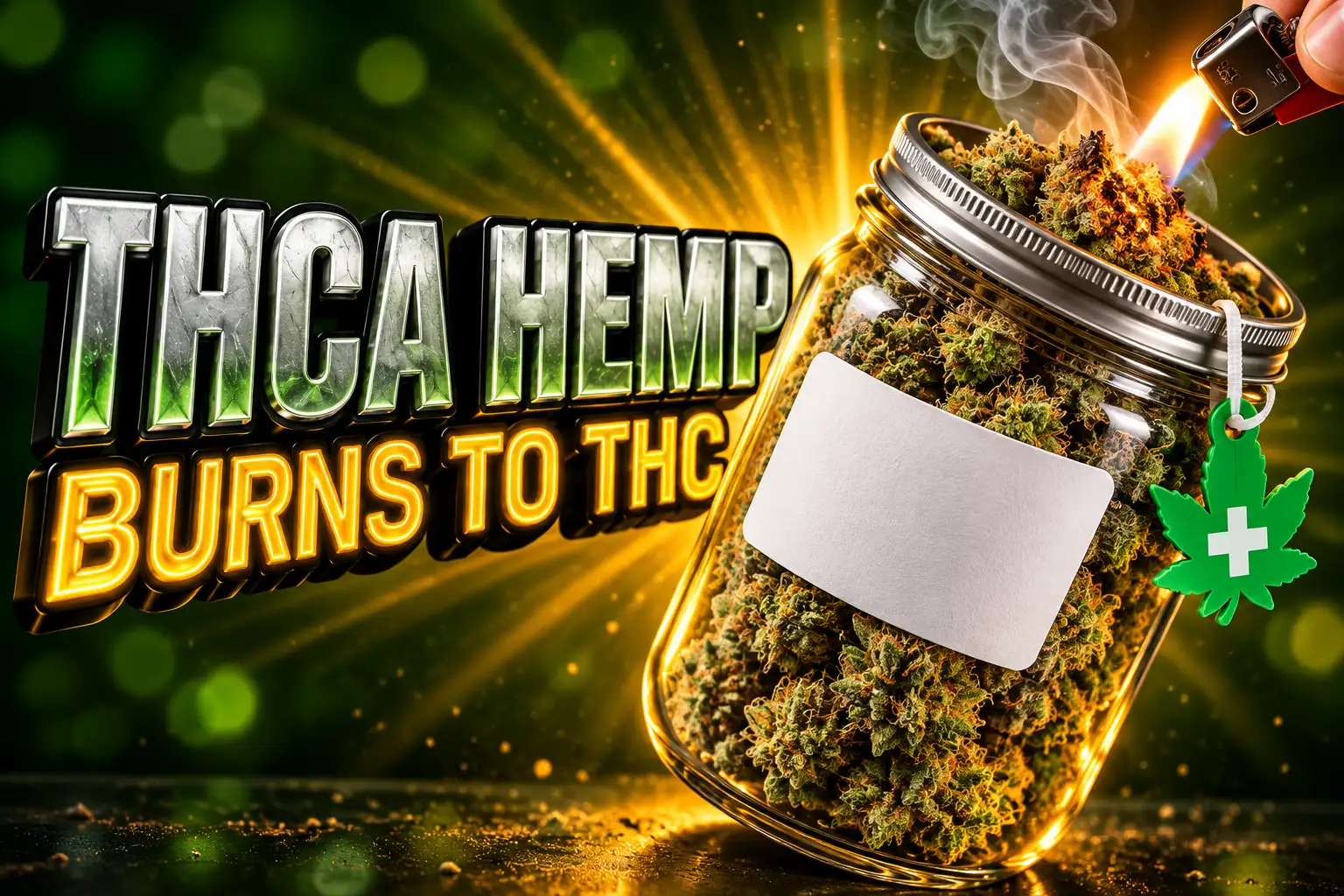
Heat Turns THCA Into Delta-9 THC
The product that soured the new career is not black-market brick weed. It is hemp flower and vapes sold at smoke shops, gas stations and liquor stores with no medical card, no seed-to-shelf ledger and a lab number that looks legal until someone puts fire to it.
Congress legalized hemp in the 2018 farm bill by drawing a line at 0.3 percent delta-9 THC by dry weight. Delta-9 is the compound that produces a high. Labs that test only that line can pass a jar packed with THCA, the acid form sitting in the raw plant. Heat knocks the acid group off. The smoke is delta-9.
THCA, IN PLAIN TERMS
- The molecule: THCA is THC with an extra acid group, abundant in unburned flower.
- The change: Burning, vaping or baking strips that group and leaves delta-9 THC.
- The test trick: A delta-9-only dry-weight test can treat hot flower as hemp if the unburned delta-9 stays under 0.3 percent.
Welsh’s version of that chemistry is a bottle with the cap still on. “It’s like me saying, ‘Here’s a bottle of vodka, but it’s not really vodka until you take the cap off and take a drink,’” he said. Most of the high from any cannabis, including Dakota Herb’s own crop, comes from unlocking THCA with temperature. By the farm bill’s delta-9 yardstick, a lot of that licensed medical flower could be dressed up as hemp.
Joe Stavig, Dakota Herb’s chief financial officer, did not treat that as a hypothetical. “All we’d have to do is cut the tags off,” he said of the tracking tags on each plant. “Cut off the tags, make a million dollars.” They say they will not. The tags are how the state watches them. The hemp aisle does not wear tags.
What House Bill 1125 Did Not Ban
South Dakota did write a hemp-product bill in 2024. It did not write the bill Welsh needed.
THE DATES THAT BUILT THE HOLE

The Justice Department Told Marijuana Testers They Lack Standing

The DEA Hearing Left Adult-Use Cannabis on Schedule I

Two Republicans Ask Treasury to Keep the Marijuana Tax Penalty

The Cannabis Banking Bill Sits Idle in Tim Scott’s Committee

Indiana’s Two-Ounce Marijuana Bill Died Without a Hearing

Vermont Stripped Psilocybin Legalization and Still Has No Therapy Program

Demecan’s €100 Million Round Was a Sales Bet

Cann Group’s $15 Million Obsidian Facility Ended in a Buyout

Identifying Cannabis Grow Houses: Key Signs to Watch For

White House Drug Office Puts Lev Back on Medical Policy
-
 LAW3 years ago
Vermont Stripped Psilocybin Legalization and Still Has No Therapy Program
-
 CANNABIS2 years ago
Demecan’s €100 Million Round Was a Sales Bet
-
 CANNABIS3 years ago
Cann Group’s $15 Million Obsidian Facility Ended in a Buyout
-
 LAW2 years ago
New Brunswick’s Cannabis Crackdown Stops at the Reserve Line
-
 MARIJUANA1 year ago
White House Drug Office Puts Lev Back on Medical Policy
-
 NEWS2 years ago
Identifying Cannabis Grow Houses: Key Signs to Watch For
-
 CANNABIS2 years ago
Ascend Wellness Kept Its 2024 Bosses and Lost Sales
-

 CANNABIS2 years ago
DC Padlocked Green Cloud, Then Licensed the Same Owner