
MARIJUANA
White House Drug Office Puts Lev Back on Medical Policy
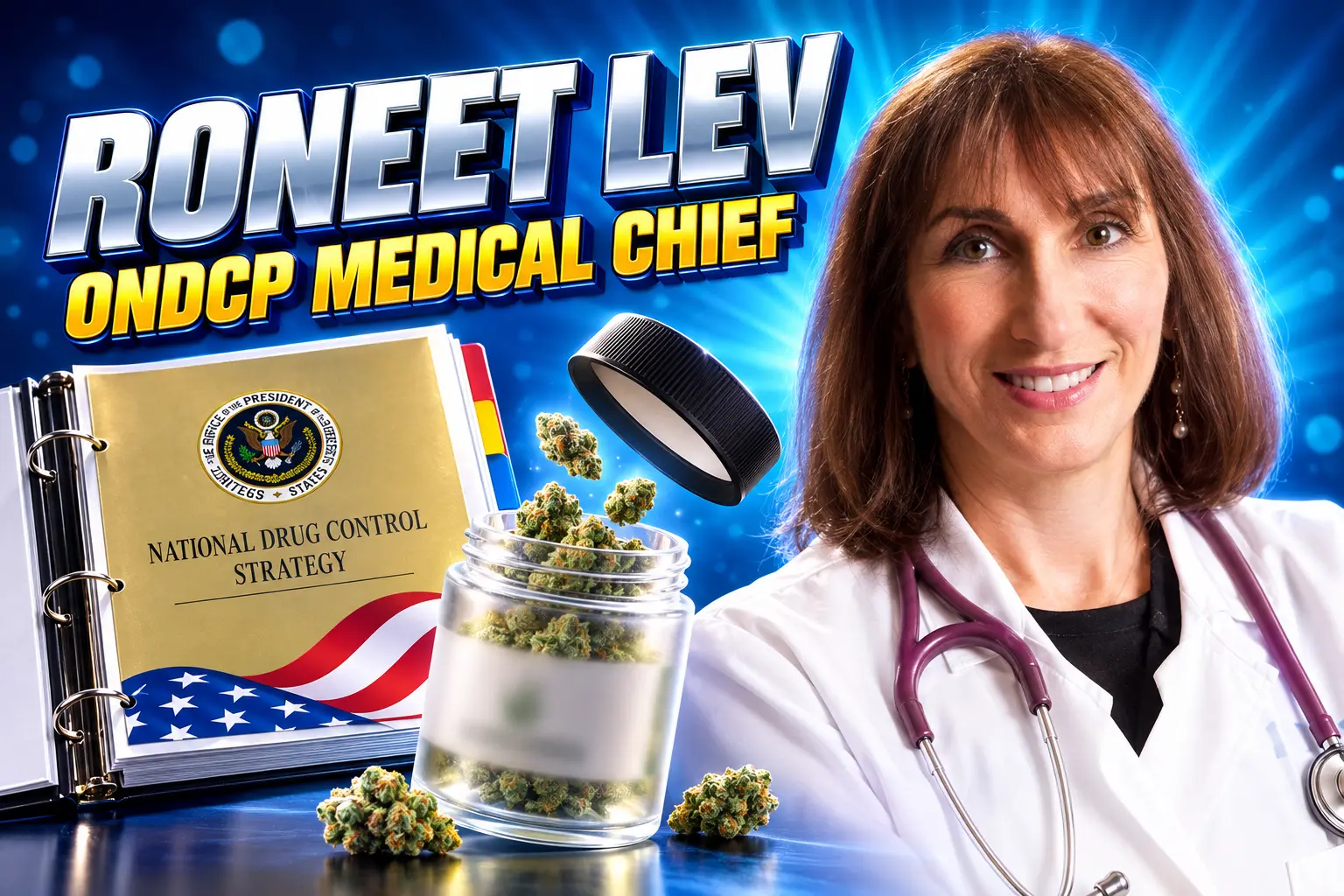
Roneet Lev is ONDCP chief medical officer again, still calling cannabis a top addiction threat after some medical marijuana moved to Schedule III.

Roneet Lev is still chief medical officer at the White House Office of National Drug Control Policy, 14 months after she took the job back. The emergency and addiction doctor spent the gap between Trump terms arguing that cannabis is not medicine, and she has not softened that brief.
In April 2026, Acting Attorney General Todd Blanche moved state-licensed medical marijuana products and FDA-approved marijuana products to Schedule III. In July, Lev told a prevention podcast that marijuana is the number one drug of addiction. The legal box for some medical cannabis already shifted. The medical talking points on the 2026 strategy circuit did not.
Lev Accepted the Job Back on July 21, 2025
Lev used a July 21, 2025 podcast message to say she had been offered, and had accepted, a post back at ONDCP. She told listeners she was pausing High Truths on Drugs and Addiction, the show she had used to argue drug policy, and she framed the return as a chance to “save lives on a much bigger scale.”
She was not a new name in that building. Lev was the office’s first chief medical officer in 2018-2020, an emergency physician with an addiction-medicine credential and a past presidency at California ACEP, the state emergency-physicians group. Smart Approaches to Marijuana, the prohibition shop run by Kevin Sabet, congratulated her the same day she announced the return.
She did not mention marijuana in that short episode. She did not need to. Anyone who had heard the show already knew the file she would carry in.
The Cannabis Record She Carried In
Lev’s cannabis case is an ER doctor’s case. She talks pediatric poisonings, emergency visits, high-potency products, and mental-health harm, and she treats commercial legalization as an industry project rather than a public-health one. In June 2024 she sat with Bertha Madras, a former ONDCP official, and spent more than an hour attacking the HHS recommendation to move marijuana from Schedule I to Schedule III.
People who accepted that science, “including some in the medical community,” were “drinking that same Kool Aid again,” she said, the way they had with prescription opioids. She called the HHS review a 90-page document with mistakes in “like every single sentence,” and she described cannabis as “a plant with 500 different chemicals, 60 different cannabinoids,” many unstudied, including toxins and carcinogens. None of the science, she said, used the high-potency products on the market, and there was “no consideration to the severe mental health impacts.”
When it comes to marijuana, the harms are right in front of our eyes
Roneet Lev, emergency and addiction physician, High Truths on Drugs and Addiction, June 2024
She went on, outside that clip, to say officials then ignore the data and follow industry talking points the way they did in the OxyContin years. She also said she knows people at NIDA, DEA, and CDC who opposed the rescheduling proposal, and she rejected the claim that Schedule III would open research. State medical programs, she said, are run by the cannabis industry, not by independent public-health people, and she pointed to pediatric poisonings and emergency visits as proof the model had failed.
LEV ON CANNABIS, YEAR BY YEAR
- April 6, 2018: Attends a Smart Approaches to Marijuana event and posts “Marijuana Death Diaries,” pressing CDC to treat cannabis as a public-health crisis.
- 2020: Quotes a SAM post about a teen whose parents blamed cannabis in a suicide and adds, “marijuana hijacks your brain.”
- April 6, 2022: Promotes an opinion piece arguing cannabis should carry a suicide-risk warning label the way tobacco does.
- 2022: Testifies for California ACEP on SB 1097, a bill to tighten cannabis product labeling, a harm-warning fight rather than a legalization fight.
- March 2024: Tells a Missouri audience it is “an insult to our profession” to call marijuana medical.
- June 2024: Attacks the HHS Schedule III recommendation on her podcast with Madras and compares the science to opioid “Kool Aid.”
- October 2024: Opposes Florida’s Amendment 3 adult-use measure, which needed 60 percent and failed, even after Donald Trump endorsed it on the campaign trail.
- July 21, 2025: Accepts the ONDCP medical job and pauses High Truths.
- July 2026: Tells the Drug Free America Foundation that marijuana is the number one drug of addiction and that people have “died from marijuana harms.”
On the Florida episode she wondered whether Trump had “really read the amendment or really understands the impact of it,” and she said she wanted “two minutes with President Trump, because I feel like I could convince him on that.” She also compared letting “big marijuana” write the rules to letting big tobacco set nicotine potency or letting Purdue Pharma run opioid prescribing. That is the voice that walked back into the drug office.
A Drug Czar Who Likes Medical Cannabis
The hire sat next to a director who talks about medical marijuana in the opposite register. Sara Carter, who leads ONDCP, has called medical marijuana a “fantastic” treatment option for seriously ill patients and has said she does not have a “problem” with legalization even if she might not personally agree with the policy.
Trump, for his part, endorsed the Florida adult-use amendment in 2024 and has supported medical cannabis and rescheduling. Blanche then used the Justice Department’s scheduling power in April 2026 on state medical and FDA products. Lev’s public file still treats “medical” as a branding insult.
FOUR WHITE HOUSE LINES ON CANNABIS
| Person | Role | Public line |
|---|---|---|
| Roneet Lev | ONDCP chief medical officer | Calling cannabis “medical” is an insult to the profession; marijuana is the number one drug of addiction; the HHS Schedule III science is industry Kool-Aid |
| Sara Carter | ONDCP director | Medical marijuana is a “fantastic” treatment option for seriously ill patients; she does not have a “problem” with legalization even if she might not personally agree |
| Donald Trump | President | Endorsed Florida’s 2024 adult-use Amendment 3; has supported medical cannabis and federal rescheduling |
| Todd Blanche | Acting U.S. attorney general | April 2026 order moved state-licensed medical marijuana products and FDA-approved marijuana products to Schedule III; a hearing still takes up broader rescheduling |
That table is the second-order fact. The director can praise medical cannabis. The president can campaign on it. Justice can move a slice of products. The doctor who briefs the science, the prevention chapters, and the outside interviews still talks about death diaries, suicide labels, and opioid-style capture.
What the Drug Office Doctor Controls
The chief medical officer does not sign DEA final rules and does not move a plant from one schedule to another. She does sit in the shop that writes the National Drug Control Strategy, supplies medical language for interagency work, and speaks for the White House on prevention stages. In 2019 SAMHSA meeting minutes described Lev, then the first person in the role, as charged with providing medical leadership and coordinating drug-policy medical work across agencies.
A later legal essay on scheduling power notes that the president sets drug-control priorities through ONDCP, which sits in the Executive Office of the President. That is the channel. Strategy language, prevention grants, and the medical sentences other agencies have to live with come through that office even when Justice holds the scheduling pen.
Lev has been using that channel in public. On July 29, 2026, Drug Free America Foundation posted her as the ONDCP voice explaining what the 2026 National Drug Control Strategy means for prevention, coalition building, faith, recovery, and “creating a drug-free America as the social norm.” That is not a side hobby. It is the medical officer doing the strategy tour.
Some Medical Cannabis Moved to Schedule III in April
The Biden-era proposal to move marijuana from Schedule I to Schedule III sat frozen through the 2025 confirmation fights. In April 2026 Blanche issued an order that did something narrower and faster: marijuana products regulated by a state medical cannabis license moved to Schedule III, and so did marijuana products approved by the FDA. An administrative hearing is still considering broader marijuana rescheduling.
That split matters because Schedule I and Schedule III are not adjacent talking points. They are different legal boxes. DEA’s public scheduling page still lists marijuana among Schedule I examples, the category it defines as having no currently accepted medical use and a high potential for abuse, alongside heroin, LSD, ecstasy, methaqualone, and peyote. The April order is a product-level move for state medical and FDA items, not a rewrite of that consumer explainer.
HOW DEA DEFINES THE BOXES
- Schedule I: Drugs with no currently accepted medical use and a high potential for abuse; DEA’s examples include heroin, LSD, marijuana (cannabis), ecstasy, methaqualone, and peyote.
- Schedule II: High potential for abuse that can lead to severe dependence; examples include fentanyl, oxycodone, methadone, cocaine, and Adderall.
- Schedule III: Moderate to low potential for physical and psychological dependence, below I and II; examples include products with less than 90 milligrams of codeine per dosage unit, ketamine, anabolic steroids, and testosterone.
HHS had already told DEA that marijuana met the medical-use test for Schedule III. Lev’s 2024 attack on that review was that the document told the public “this is medicine, this is safe, this is monitored” when, in her view, those lines were “false to us physicians and scientists who review this material.” She also warned that a U.S. move could collide with international drug treaties and, in her telling, weaken the country’s hand with China and Mexico on fentanyl. The April order did not answer that brief. It just moved some products anyway.
She Still Ranks Marijuana as the Top Addiction
On the Drug Free America Foundation’s Pathways to Prevention podcast last July, Lev said she keeps pictures of people who “tragically died” as a result of drugs so they do not “die in vain.” The first wave, she said, was parents who lost children to oxycodone and then fentanyl. Then she added marijuana to that wall.
And we also remember the victims of marijuana, the people who’ve died from marijuana harms as well
Roneet Lev, ONDCP chief medical officer, Pathways to Prevention podcast, July 2026
She then said “the number one drug of addiction is marijuana,” and that for the first time in U.S. history the rate of substance use disorder is over the rate of alcohol use disorder, because of marijuana. A federal study released in July 2026 found Americans are now more likely to use marijuana nearly every day than they are to drink alcohol or smoke cigarettes on a daily basis, which is the prevalence backdrop she is pressing into an addiction ranking.
The weak point in that public case is lethality. DEA has said “no deaths from overdose of marijuana have been reported.” Lev’s phrasing is “marijuana harms,” a wider net that can take in crashes, suicides, and other deaths where cannabis is in the story rather than a classic toxic overdose. That gap is what her critics hear first, and it is the line she has not tightened.
She told listeners that people with marijuana use disorder “should be able to stop,” the way many people quit cigarettes without a medicine, and that the government wants “informed decisions.” Her practical tip was to check cannabis, marijuana, or cannabidiol against other drugs on drugs.com, because “there are hundreds of medications that interact with marijuana.” She also said smoke-shop marijuana, hemp, and psychedelic products have not gone through testing, “you really don’t know what you’re buying,” and “you can’t count on the labels being correct.” Legalization advocates answer that testing and labels are what a regulated market is for. She uses the same mess as evidence the market should not exist.
Drug Free America posted her interview on the 2026 strategy as a prevention briefing, not a cannabis debate. That is how the medical brief travels now.
What does the 2026 National Drug Control Strategy mean for #prevention?
Dr. Roneet Lev of @ONDCP discusses primary prevention, coalition building, faith, recovery, and creating a drug-free America as the social norm.
Tune in here: https://t.co/Z4ZcUzwtdW#P2P #ONDCP pic.twitter.com/wn8Tjy6YIa
— DrugFreeAmerica (@DrugFreeAmerica) July 29, 2026
ONDCP can live with that split because the jobs are split. Blanche can move products. Carter can call medical marijuana fantastic. Lev can still tell prevention coalitions that the social norm is a drug-free America and that marijuana is the addiction to treat first.
The Fentanyl Summit Is the Day Job Now
On September 15, 2026, ONDCP posted that its chief medical officer, Dr. Lev, was meeting California HIDTA leaders at the Western States Fentanyl Case Collaborative Summit. The caption was fentanyl, not flower. That is the job as the office wants it seen: cartels, HIDTA case work, overdose, treatment first.
ONDCP’s Chief Medical Officer, Dr. Lev, meets with California HIDTA leaders at the Western States Fentanyl Case Collaborative Summit. pic.twitter.com/zZPPIlhTdO
— ONDCP (@ONDCP) September 15, 2026
In August, HHS Rapid Response circulated her line that “Housing without treatment is DEADLY,” a shot at Housing First, which shows the same instinct she brings to cannabis. The medical officer’s product is a harm brief. Cannabis is one chapter of it, and it is the chapter she has been writing in public for years.
The April Schedule III slice did not retire that chapter. It put a doctor who calls medical cannabis an insult in the same White House that now has state medical products in a less restricted box, and it left her on the 2026 strategy circuit to say the addiction ranking anyway. The hearing on broader rescheduling is still open. The medical microphone is already staffed.
Disclaimer: This article is news reporting and analysis of public statements, agency pages, and federal scheduling actions. It is informational only and is not medical advice, legal advice, or a recommendation to use, avoid, buy, or sell cannabis or any other controlled substance. Readers with health questions should consult a licensed physician, and readers with questions about cannabis law, scheduling, or employment rules should consult a qualified attorney. Figures, job titles, and scheduling status reflect the primary pages and public remarks cited here and can change as DEA, HHS, or the White House issues new documents.

The Justice Department Told Marijuana Testers They Lack Standing

The DEA Hearing Left Adult-Use Cannabis on Schedule I

Two Republicans Ask Treasury to Keep the Marijuana Tax Penalty

The Cannabis Banking Bill Sits Idle in Tim Scott’s Committee

Indiana’s Two-Ounce Marijuana Bill Died Without a Hearing

Vermont Stripped Psilocybin Legalization and Still Has No Therapy Program

Demecan’s €100 Million Round Was a Sales Bet

Cann Group’s $15 Million Obsidian Facility Ended in a Buyout

Identifying Cannabis Grow Houses: Key Signs to Watch For

White House Drug Office Puts Lev Back on Medical Policy
-
 LAW3 years ago
Vermont Stripped Psilocybin Legalization and Still Has No Therapy Program
-
 CANNABIS2 years ago
Demecan’s €100 Million Round Was a Sales Bet
-
 CANNABIS3 years ago
Cann Group’s $15 Million Obsidian Facility Ended in a Buyout
-
 NEWS2 years ago
Identifying Cannabis Grow Houses: Key Signs to Watch For
-

 LAW2 years ago
New Brunswick’s Cannabis Crackdown Stops at the Reserve Line
-

 CANNABIS2 years ago
Ascend Wellness Kept Its 2024 Bosses and Lost Sales
-

 CANNABIS2 years ago
DC Padlocked Green Cloud, Then Licensed the Same Owner
-

 CANNABIS2 years ago
Pipeline’s Cannabis Concert Plan Is Still a 2025 Promise