
LAW
The Cannabis Banking Bill Sits Idle in Tim Scott’s Committee
Tim Scott said Congress must legalize marijuana for cannabis banking, then left the SAFE Banking Act idle in his own Senate committee.

Senate Banking Chair Tim Scott said in May 2026 that Congress must make marijuana legal before banks can serve state-licensed cannabis firms. On June 24 the safe-harbor bill meant to do that job was referred to the Banking Committee, and the official record still shows that referral as the last action.
Scott, a South Carolina Republican, warned about cash rooms holding hundreds of thousands of dollars. He has not scheduled a markup.
Scott’s Legalization Bar for Cannabis Banks
Speaking on May 5, 2026, during an appearance carried on C-SPAN, Scott treated rescheduling as unfinished business for banks. President Donald Trump had already ordered a push in December 2025 to move marijuana toward Schedule III, and the Justice Department followed in April with a medical-product order. Scott still called the plant illegal at the federal level.
“Congress is going to have to make it legal, because today even though the president has declassified it or reduced its impact, the truth is it is still illegal,” Scott said. Until that changes, he added, the federal banking system cannot open the door.
He pointed to a cannabis banking bill as the way “to allow for the banking question to be solved by making it legal to bank it.” That is a narrower claim than making the plant itself legal, and the two are easy to mash together. The SAFE Banking Act does not deschedule marijuana. It would shield banks that serve state-licensed shops while the Controlled Substances Act still treats adult-use sales as a federal crime.
What you don’t want is to have a situation where you have these cash rooms where you have hundreds of thousands of dollars cash sitting in a location. Everyone knows you can’t bank it and therefore the criminal activity is much higher in these places.
Tim Scott, Senate Banking Committee chair, on C-SPAN, May 5, 2026
He closed the thought with a promise that “we’ll get to a solution.” The chair who named the cash-room problem did not put his name on the bill that later landed on his calendar. Sen. Jeff Merkley, an Oregon Democrat, did.
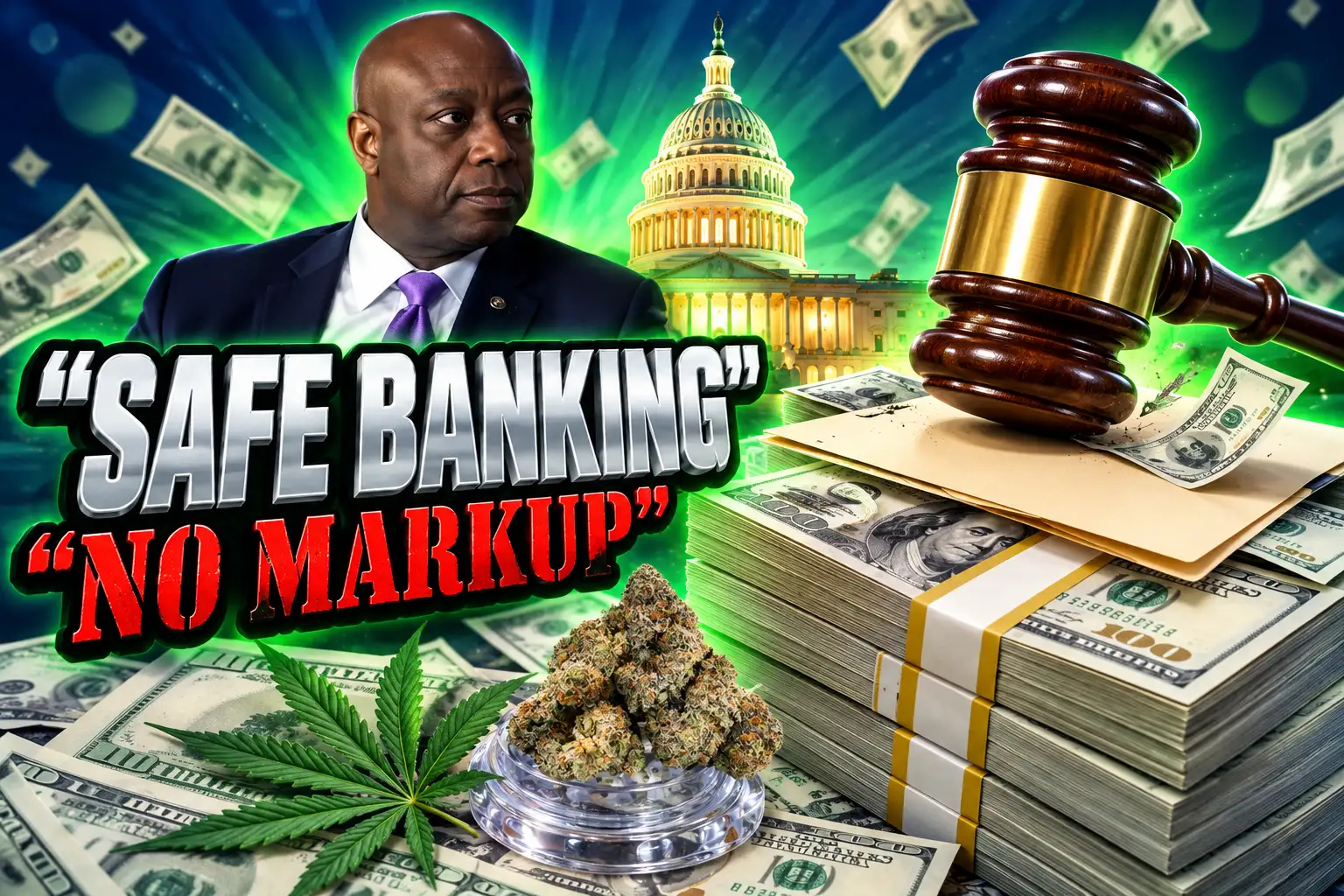
S.4942 Landed in His Committee in June
Merkley filed the Secure And Fair Enforcement Banking Act of 2026 on June 24, 2026, with Sens. Lisa Murkowski (R-AK), Elizabeth Warren (D-MA), and Steve Daines (R-MT). The Senate read it twice and sent S.4942 to Banking, Housing, and Urban Affairs, the panel Scott chairs. Congress.gov still lists the bill as introduced.
Rep. Dave Joyce (R-OH) led a House companion filed a day later as H.R. 9471, with seven colleagues from both parties, including Reps. Jim Himes (D-CT), Warren Davidson (R-OH), Nydia Velázquez (D-NY), Brian Mast (R-FL), Lou Correa (D-CA), Dina Titus (D-NV), and Guy Reschenthaler (R-PA). On July 17, 2026, the House sent that bill to the Subcommittee on Economic Opportunity. It has not reached a floor vote either.
WHERE THE 2026 BILLS STAND
| Bill | Chamber | Date filed | Latest action |
|---|---|---|---|
| SAFE Banking Act of 2026 (S.4942) | Senate | June 24, 2026 | Referred to Banking, Housing, and Urban Affairs |
| SAFE Banking Act of 2026 (H.R. 9471) | House | June 25, 2026 | Referred to Economic Opportunity subcommittee on July 17, 2026 |
| SAFER Banking Act (S.2860) | Senate | September 20, 2023 | Committee passed 14-9 on September 27, 2023; no floor vote |
| SAFE Banking Act of 2019 (H.R. 1595) | House | September 25, 2019 | Passed 321-103; died in the Senate |
The 2026 Senate text would bar federal banking regulators from punishing or discouraging a bank for serving a state-sanctioned marijuana business, or a landlord, lawyer, or vendor tied to one. It would protect federal deposit insurance, create a safe harbor from prosecution and asset forfeiture for the bank and its staff, and cover hemp and CBD firms. Banks would still choose their customers. They would still file suspicious activity reports.
Why Licensed Shops Still Run on Cash
Federal law still makes it a crime to manufacture, distribute, or dispense marijuana, so a licensed dispensary’s deposits are, in the Bank Secrecy Act’s eyes, funds from illegal activity. That is why a state license does not get a shop a normal checking account, and why Scott’s cash-room warning still describes the daily run at many storefronts.
FinCEN’s February 14, 2014 guidance on BSA expectations for marijuana-related businesses is still the operating manual. It tells a bank that may take the account how to file, not that the account is ordinary. Every marijuana relationship is a SAR event. That paperwork, plus exam risk, is the real lock on the vault.
THE THREE MARIJUANA SARS BANKS MUST FILE
- Marijuana Limited: The bank believes the shop is state-legal and does not trip older Justice Department enforcement priorities, and the narrative says so in those two words.
- Marijuana Priority: The bank sees red flags that look like diversion, gangs, or other crimes, and the file has to carry the dates, amounts, and the priority that was hit.
- Marijuana Termination: The bank dumps the customer to keep its anti-money-laundering program intact, and it is urged to warn the next bank through voluntary information sharing.
Rob Nichols, president and CEO of the American Bankers Association, said the clash between state and federal law has left many cannabis firms on cash, with public-safety costs in states that already license the trade. The 2026 bill would keep those SAR duties in place. It would stop regulators from treating the account itself as a reason to punish the bank.
Seven House Votes and Zero Senate Floor Dates
The House has already done this work. Between 2019 and 2022 it passed some version of SAFE Banking seven times, as a stand-alone bill and as a rider on larger packages. The Senate never gave it a floor vote, under Republican and Democratic leaders alike.
THE SENATE GRAVEYARD, IN ORDER
- September 25, 2019: The House passes H.R. 1595, 321-103, the first chamber vote on a stand-alone cannabis banking bill; the Senate Banking Committee takes no floor-bound action.
- 2019 to 2022: The House passes SAFE Banking provisions seven times; Senate negotiators strip the language from the bills that become law.
- September 27, 2023: The Senate Banking Committee, then under Democratic control, votes the renamed SAFER Banking Act out 14-9, the first cannabis bill to clear a Senate committee.
- 2023 to 2024: Majority Leader Chuck Schumer does not put SAFER on the floor. Earlier, Mitch McConnell had kept SAFE off the floor as well.
- April 2026: Acting Attorney General Todd Blanche places FDA-approved and state-licensed medical marijuana products in Schedule III; adult-use cannabis stays in Schedule I.
- May 5, 2026: Scott says Congress must make marijuana legal before federal banks can serve the industry and calls cash rooms a crime problem.
- June 24, 2026: Merkley files S.4942; Joyce follows in the House on June 25.
- June 29, 2026: DEA opens an administrative hearing on broader rescheduling, set to wrap by July 15, 2026.
- September 17, 2026: Scott’s committee meets on other business; S.4942 still has no markup date.
Former majority leaders from both parties parked the bill. Schumer held out for a wider cannabis package. McConnell never made time. The 2023 committee vote proved the language could get a bipartisan majority in Banking. It never proved the Senate would vote.
Medical in Schedule III, Adult-Use in Schedule I
Scott spoke after the April medical order, not before it. That order moved some medical products into Schedule III. It did not make adult-use stores legal under the Controlled Substances Act, and it did not rewrite the Bank Secrecy Act. Banks that already feared adult-use deposits still fear them. Some are now unsure what a medical account is worth if the same operator also sells adult-use goods under state law.
The reclassification of cannabis from Schedule I to Schedule III still leaves cannabis businesses in violation of criminal law because the production and use of cannabis for nonmedical purposes remain a federal crime. This is true even in states like Oregon that legalized recreational cannabis use more than a decade ago. As such, these legal businesses are still prevented from fully accessing the banking system.
Sen. Jeff Merkley, D-OR, May 2026
Merkley said he still wants cannabis fully descheduled. The bill he filed does not do that. It tries to let a bank take the deposit without waiting for that fight to end, which is the gap Scott’s legalization bar would leave open.
Small and Minority Shops Absorb the Cash Risk
A 2023 estimate put the share of U.S. banks willing to serve the sector at about 10 percent, and credit unions at about 5 percent. The shops that get an account often land at a regional or community institution that will take Bank Secrecy Act risk the national brands will not. Everyone else counts bills in a back room, pays vendors in cash, and moves tax money the same way.
THE CASH GAP IN HARD NUMBERS
- Bank share: About 10 percent of U.S. banks were willing to serve cannabis firms in that 2023 estimate.
- Credit unions: About 5 percent, on a separate base from the bank figure.
- House votes: Seven passes between 2019 and 2022, none matched by a Senate floor date.
- Cash on site: Scott described rooms holding hundreds of thousands of dollars because the deposits cannot go to a federal bank.
Michael Cooper, policy chair for the National Cannabis Industry Association, said access “remains severely limited for a highly regulated industry that is operating in the vast majority of the United States.” He said the squeeze “most adversely affects small and minority-owned businesses and only serves to fuel an unregulated illicit market.” The armored-car route and the cash room are operating costs those shops cannot spread the way a national chain can.
The 38-page SAFE Banking bill text would also cover the accountant, the landlord, and the payroll firm that sit one step away from the plant. Those vendors lose bank accounts too when a teller flags the industry, which is how a state-legal shop ends up paying rent in cash.
Will Scott’s Committee Mark Up SAFE Banking?
As of the official tracker, S.4942 has had no hearing and no markup in Scott’s committee since the June 24 referral. Late June filings had about six months left in the 119th Congress. By late September that window was the closing stretch, and the bill still had no date on the calendar.
On September 17, 2026, Scott convened an executive session on terrorism insurance and Trump nominees. Cannabis accounts were not on that slate. Mid-September posts that recirculated the June filing still had no Senate vote date to add.
Scott can argue he is waiting for a cleaner legalization vote, and the April medical order did not give banks that vote. He can also move a safe-harbor bill that does not legalize the plant. The text is already in his committee. The cash rooms he described are still open, and the gavel has not come down on S.4942.

The Justice Department Told Marijuana Testers They Lack Standing

The DEA Hearing Left Adult-Use Cannabis on Schedule I

Two Republicans Ask Treasury to Keep the Marijuana Tax Penalty

The Cannabis Banking Bill Sits Idle in Tim Scott’s Committee

Indiana’s Two-Ounce Marijuana Bill Died Without a Hearing

Vermont Stripped Psilocybin Legalization and Still Has No Therapy Program

Demecan’s €100 Million Round Was a Sales Bet

Cann Group’s $15 Million Obsidian Facility Ended in a Buyout

Identifying Cannabis Grow Houses: Key Signs to Watch For

White House Drug Office Puts Lev Back on Medical Policy
-
 LAW3 years ago
Vermont Stripped Psilocybin Legalization and Still Has No Therapy Program
-
 CANNABIS2 years ago
Demecan’s €100 Million Round Was a Sales Bet
-
 CANNABIS3 years ago
Cann Group’s $15 Million Obsidian Facility Ended in a Buyout
-

 CANNABIS2 years ago
DC Padlocked Green Cloud, Then Licensed the Same Owner
-
 LAW2 years ago
New Brunswick’s Cannabis Crackdown Stops at the Reserve Line
-
 MARIJUANA1 year ago
White House Drug Office Puts Lev Back on Medical Policy
-
 NEWS2 years ago
Identifying Cannabis Grow Houses: Key Signs to Watch For
-

 CANNABIS2 years ago
Ascend Wellness Kept Its 2024 Bosses and Lost Sales